
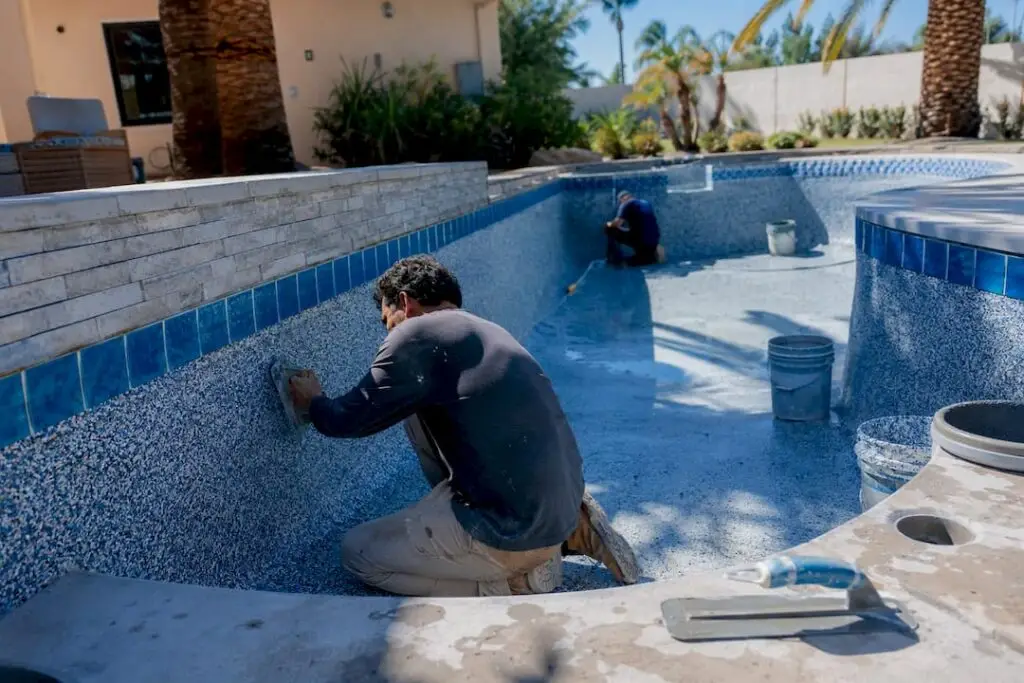
Yes, you can redo an existing pool, and for most homeowners it’s the smarter move over a full rebuild. The single most effective starting package combines a new interior finish, fresh waterline tile, new coping, and LED lighting. That trio plus lighting touches everything the eye sees and everything the water feels, without the cost or disruption of structural work.
That starter package typically runs $8,000 to $18,000 in 2026, while a full remodel with structural changes, added features, and major deck work can land anywhere from $12,000 to $60,000 or more. Where your project falls in that range depends almost entirely on scope, not luck.
Before you call anyone, run through this:
- Confirm the shell is structurally sound (no major cracks, no chronic leaks).
- Schedule an in-person contractor inspection to price the real scope, not a guess.
- If the pool will be drained anyway, bundle in a pump or equipment upgrade now.
- Ask every bidder for an itemized, sequenced scope of work, not a lump sum.
We Fix Ugly Pools® builds every remodel around the National Plasterers Council’s 28-day startup protocol, an industry standard that governs how a new finish cures and stabilizes, because skipping it is the fastest way to void a warranty.
Key Takeaways
A successful pool redo prioritizes structural and mechanical work first, then layers finish, tile, coping, and lighting for the highest visual return per dollar spent.
| Point | Details |
|---|---|
| Start with a starter package | Resurface, waterline tile, coping, and LED lighting typically cost $8,000–$18,000 and deliver the biggest visual change. |
| Sequence work correctly | Fix structure and plumbing first, then equipment, then finish, coping, and deck last to avoid paying for labor twice. |
| Match materials to your timeline | Pebble lasts 15–25+ years, quartz 10–15, and plaster 5–12; choose based on how long you’ll keep the pool. |
| Vet contractors on process, not price | Ask about NPC startup protocols, itemized scope, and warranty terms before comparing dollar figures. |
| Work with a remodel specialist | We Fix Ugly Pools® focuses exclusively on pool transformations in the Greater Phoenix area, following NPC standards on every project. |
Table of Contents
- What “Redo A Pool” Actually Includes
- Which Upgrades Give You The Best Return Per Dollar?
- How Much Does A Pool Redo Cost In 2026?
- Which Materials And Finishes Last Longest?
- What’s The Right Order To Do The Work?
- How Do You Choose The Right Remodeler?
- Which Equipment Upgrades Actually Pay For Themselves?
- Why Hire A Remodel Specialist Instead Of A General Pool Company?
- What Most Remodel Advice Gets Backward
- Ready For A Professional Quote On Your Pool Redo?
- Sources
What “Redo A Pool” Actually Includes
“Redo a pool” covers a wide spectrum of work, and the phrase means something different depending on your budget. The industry term you’ll hear from contractors is pool renovation or pool remodeling, and it breaks into three practical tiers.
- Minor refresh: new interior finish, waterline tile, coping, and LED lighting. Cosmetic, fast, and the highest return per dollar spent.
- Mid-range remodel: everything above, plus deck resurfacing or replacement and an equipment upgrade (pump, filter, heater).
- Full remodel: structural modifications, an added spa or tanning ledge, major deck reconstruction, and sometimes a shape change.
A few example profiles show how this plays out. A homeowner chasing a quick cosmetic update might spend $10,000 on finish, tile, and coping over one week. A family focused on lower bills might spend $14,000 adding a variable-speed pump and LED lighting to that same package. A homeowner planning to entertain for years might commit $35,000 to $45,000 on a tanning ledge, upgraded decking, and a full mechanical overhaul.
Not every pool type takes every scope equally well. Concrete and gunite pools are the most flexible. They accept nearly any finish, shape change, or added feature. Vinyl liner pools are generally limited to liner replacement and equipment work; structural shape changes usually mean a rebuild. Fiberglass shells can be refinished cosmetically but rarely support major structural modification. If you’re unsure which category your project falls into, a renovation versus repair comparison is worth reading before you get quotes.

Which Upgrades Give You The Best Return Per Dollar?
Not all upgrades are created equal, and ranking them by impact-per-dollar changes how most homeowners should spend their budget. Here’s the order that actually makes sense, based on visual impact, lifespan, and labor overlap with resurfacing:
- Interior finish/resurface. This is the biggest single visual change you can make, and it’s the foundation everything else depends on. Resurfacing typically runs a few thousand dollars to well over $10,000 depending on material.
- Waterline tile. Small footprint, disproportionate visual payoff, and it’s most cost-effective when installed during the same labor window as resurfacing.
- Coping. Frames the entire pool visually and affects safety underfoot; replacing it alongside the interior finish avoids a second demolition pass.
- LED lighting. Cheap relative to everything above it, and it transforms how the pool reads at night more than almost any other single change.
- Decks, features, and equipment. High-value, but lower on the per-dollar ranking because the visual return is more gradual and the cost climbs faster.
Pro Tip: Dark interior finishes look dramatic in photos, but they absorb more heat and can make water feel noticeably warmer in direct sun. They also shift in tone depending on depth and sky conditions, so ask to see a sample panel in full sunlight before committing.
How Much Does A Pool Redo Cost In 2026?
Cost is the question every homeowner actually wants answered, and the honest answer is: it depends heavily on which components you touch. Here’s what typical 2026 pricing looks like by project component.

Three realistic bundles help translate that table into a decision. A starter refresh (finish + tile + coping + lighting) lands in the $8,000 to $18,000 range. A mid-range remodel adding a deck and equipment upgrade typically runs $20,000 to $35,000. A full remodel with structural work, an added spa or ledge, and complete deck reconstruction runs $40,000 to $60,000 or more.
The biggest budget drivers are almost always deck square footage and any added water feature. When you’re comparing quotes, treat an unusually low bid as a warning sign rather than a win. A price that skips demolition to bare shell, or that doesn’t mention startup chemistry, usually means corners are being cut somewhere you can’t see until the finish fails early.
Which Materials And Finishes Last Longest?
The finish you choose determines how the pool looks day one, and how much you’ll spend maintaining it for the next decade. Lifespan varies more than most homeowners expect.
- Plaster: the most affordable option, smooth and classic, but the shortest lifespan at roughly 5 to 12 years.
- Quartz/aggregate: a step up in durability and texture, typically lasting 10 to 15 years.
- Pebble: the premium choice for texture and longevity, often lasting 15 to 25-plus years, though it costs more upfront. If you’re weighing pebble specifically, a deeper look at pebble surfaces covers the visual and durability trade-offs.
- Tile: extremely durable and available in nearly unlimited patterns; best explored through a tile selection guide before you commit to a design.
- Fiberglass refinish: cosmetic-only, generally shorter-lived than a full resurface on gunite.
- Vinyl liner replacement: the standard renovation path for liner pools, with lifespan tied heavily to liner thickness and water chemistry.
Coping material matters just as much. Travertine stays cooler underfoot and looks upscale but costs more; poured concrete is budget-friendly but less distinctive; large-format stone and pavers each trade cost against slip resistance and maintenance.
Pro Tip: If you plan to keep the pool for 15 years or more, spend the extra money on pebble or quartz now. Trendy tile patterns and finish colors age faster than classic ones, and replacing a finish early costs far more than upgrading it once, correctly.
What’s The Right Order To Do The Work?
Sequencing determines whether you pay once or pay twice for the same labor. The order that saves money follows a specific logic: structural and plumbing work first, then equipment and electrical, then tile and interior finish, then coping, and finally deck, lighting, and landscaping.
- Structural repairs and plumbing additions (while the shell is exposed and drained).
- Equipment and electrical upgrades.
- Tile and interior finish application.
- Coping installation.
- Deck, lighting, and landscaping.
Typical timelines vary by scope. A resurface-only project runs 5 to 10 days, a mid-range remodel takes 10 to 14 days, and a full remodel with structural changes takes 3 to 4 weeks. Every finish also needs curing time before startup chemistry begins, and rushing that window is the most common cause of early finish failure.
- Add major features (spa, tanning ledge) while the pool is already drained.
- Upgrade the pump during the same drain window to avoid paying for a second one later.
- Book off-season if your climate allows; a market timing guide breaks down when contractors have more scheduling flexibility.
How Do You Choose The Right Remodeler?
The contractor you hire matters more than the material you pick, because even the best finish fails if it’s installed poorly. Ask every bidder these questions before signing anything:
- Are you licensed and insured for pool construction in this state?
- Do you follow NPC startup and plaster protocols, and can you explain them?
- Can I get an itemized scope of work instead of a lump-sum number?
- What’s your change-order policy if hidden damage turns up?
- What warranty applies to the finish, and what voids it?
- Can I see references and a portfolio of completed remodels?
Watch for these red flags: a bid that’s dramatically lower than every other quote, a vague scope that doesn’t name materials or square footage, any mention of resurfacing over the existing finish instead of demolishing to bare shell, and no mention of startup chemistry at all. Complete removal to bare shell followed by the NPC 28-day protocol is what separates a finish that lasts 20 years from one that fails in 8.
As a rule of thumb, always get an itemized quote, budget a 10 to 20 percent contingency for surprises once the shell is exposed, and prioritize finish and mechanical work over cosmetic extras if your budget forces a choice.
Which Equipment Upgrades Actually Pay For Themselves?
A remodel is the cheapest moment to touch your equipment pad, because the labor and access costs are already being absorbed by the resurfacing work. A few upgrades consistently deliver the fastest payback.
- Variable-speed pump: reduces energy use substantially compared to a single-speed pump running on one setting all day.
- LED lighting conversion: cuts lighting electricity costs meaningfully while also lasting far longer than incandescent bulbs.
- Flow automation: lets you schedule pump and filtration cycles for off-peak utility rates.
- Salt conversion: trades a slightly higher upfront cost for lower long-term chemical spending, though it isn’t the right fit for every finish type.
Check your local utility provider for rebates on pumps and LED conversions before you finalize your equipment list. Installing them during the remodel, while everything is already open and accessible, is nearly always cheaper than retrofitting them later. A lighting design guide covers the design side of that decision.
Why Hire A Remodel Specialist Instead Of A General Pool Company?
A pool that’s remodeled out of sequence often needs to be reopened within a year or two, and that second disruption costs more than doing it right the first time. Structure and plumbing first, finishes second, isn’t just theory. It’s the difference between one labor mobilization and two.
A remodeler who fixes outdated plumbing and electrical while the shell is already drained for resurfacing does that work at a fraction of what it costs as a standalone repair later. The same logic applies to adding a spa or tanning ledge: integrating it into the resurface project is dramatically cheaper than retrofitting it after the fact.
We Fix Ugly Pools® has spent a decade specializing exclusively in pool transformations across the Greater Phoenix area, with a portfolio of completed projects and homeowner testimonials backing that focus. What that specialization buys you:
- Structural inspection before any resurfacing quote is finalized.
- Plumbing and electrical addressed while the shell is exposed, not after.
- Adherence to NPC startup protocols on every finish application.
- A documented process homeowners can review before work begins.
Pro Tip: Ask any remodeler to walk you through their process for a project similar in size to yours, start to finish. A specialist can do this in detail; a generalist usually can’t.
What Most Remodel Advice Gets Backward
Most pool remodel content leads with features. Grottos, waterfalls, sun shelves, the fun stuff. That’s backward for most budgets. The finish, tile, and coping trio isn’t the exciting part of a remodel, but it’s the part that touches every square inch of the pool and the part every visitor actually notices first.
The conventional advice to “get three quotes and pick the middle one” also falls short. Price alone tells you nothing about whether a contractor is demolishing to bare shell or resurfacing over old material, or whether they’re following a real startup chemistry protocol. Two bids can look identical on paper and produce a finish that lasts 8 years versus one that lasts 20.
If you take one thing from this, prioritize sequencing over shopping. Structural and mechanical fixes belong first, while the shell is already open. Everything cosmetic layers on top of that foundation. Homeowners who chase the pretty parts first, and treat structure as an afterthought, are the ones calling a second contractor two years later to fix what the first one should have caught.
Ready For A Professional Quote On Your Pool Redo?
If you’ve read this far, you already know the finish, tile, coping, and lighting package is where your money works hardest, and now you need someone who can turn that plan into an actual schedule. Wefixuglypools has spent a decade in the Greater Phoenix area doing exactly this kind of remodel, and a quote from us isn’t a rough number scribbled on a business card.

A site visit includes a structural inspection, an itemized scope broken down by component, a realistic sequencing plan, and a written timeline you can hold a contractor to. You’ll also see a portfolio of completed transformations and can request references from homeowners with a similar scope to yours. Every finish we install follows NPC startup chemistry, and we’ll flag mechanical upgrades worth bundling in while your pool is already drained, since that’s where the real savings show up.
Ready to see what your project actually costs? Start your remodel with a quote and get an itemized plan built around your pool, not a generic package.
Sources
- Pool Remodel Ideas & Costs to Modernize in 2026 | PoolPad
- The Complete Guide to Pool Renovation in 2026: What to Upgrade, What to Skip, and What It Actually Costs – Modern Pool Tools
- 6 Pool Resurfacing Options Compared (w/ Costs & Pros/Cons) | SKIN Microplaster


