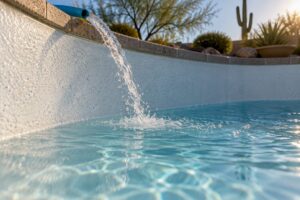
Rectangular and geometric pools are the clear answer to what pool style sells best. They hold approximately 85% of consumer selections in new luxury construction, pair with virtually every home style, and accept the features buyers value most: tanning ledges, automatic safety covers, and smart automation. If you’re choosing a pool style for resale, start here.
Quick TL;DR:
- Best for broad resale appeal: Rectangular or geometric (works on most lots, most price bands)
- Best for tight lots or investors: Plunge or cocktail pools (lower cost, premium features)
- Best for luxury view properties: Vanishing/infinity edge (site-specific, high premium)
Table of Contents
- Why pool style matters for resale value
- Which pool styles sell best? A style-by-style breakdown
- What features do buyers actually notice?
- Which finishes and materials raise buyer appeal?
- What do new builds and remodels actually cost?
- How to choose the right pool style for your property
- Wefixuglypools helps you build a resale-first pool
- Key Takeaways
- A builder’s perspective on choosing the right style
- Useful sources and further reading
Why pool style matters for resale value
Style is not just aesthetics. It shapes how a buyer perceives permanence, maintenance burden, and future flexibility. A pool that clashes with the home’s architecture or requires expensive modification to add a safety cover creates friction at the point of sale.
Design professionals now treat pools as architectural extensions of the house, not standalone features. Clean-lined contemporary homes pair naturally with rectangular or geometric pools. Resort-style or tropical properties can carry a freeform or lagoon design without looking mismatched. The wrong pairing signals “renovation project” to a buyer.
Neighborhood norms matter too. In the Southwest, a pool is often expected. In the Northeast, it’s a differentiator. In either market, a pool that fits the price band and lot size reads as an asset. One that overwhelms a small yard or looks dated reads as a liability.
Practical resale advantages of rectangular designs:
- Accept automatic safety covers more easily than heavily freeform shapes, reducing buyer hesitation around safety and insurance
- Accommodate swim lanes, tanning ledges, and spillover spas without awkward geometry
- Simpler to resurface and maintain, which buyers factor into long-term cost
Pro Tip: A smaller pool with a tanning ledge, integrated lighting, and quality finish will usually outperform a larger, plain pool in buyer appeal. Spend on features before you spend on square footage.
Which pool styles sell best? A style-by-style breakdown
Rectangular and geometric
The resale default. Rectangular pools offer timeless lines that complement both contemporary and traditional homes equally well. They maximize usable swim area within a given footprint, simplify construction, and are the most compatible with automatic covers. Geometric variants (L-shapes, T-shapes, offset spas) give you design flexibility while preserving the clean lines buyers respond to.
Pros: Broad buyer appeal, feature-compatible, easier to cover and maintain
Cons: Can feel institutional without softening details (rounded coping, integrated spa)
Ideal for: Modern homes, traditional homes, investors targeting broad buyer pools
Ballpark cost: $50,000–$100,000+ for new gunite build; fiberglass shells typically lower
Plunge and cocktail pools
The 2026 shift toward smaller, smarter pools is real and buyer-driven. Homeowners are choosing compact footprints and redirecting budget toward automation, premium lighting, and landscaping. On urban lots or investment properties, a well-appointed plunge pool often delivers better perceived value per dollar than a large plain pool.

Pros: Lower install and maintenance cost, leaves budget for high-impact features, fits tight lots
Cons: Limited lap swimming, may not satisfy buyers with families
Ideal for: Urban properties, investors, small lots, vacation rentals
Freeform and lagoon
When the property has the lot size and the architecture to support it, a freeform or lagoon design can genuinely boost value. Think resort-style homes, large private lots, or vacation markets. The tradeoff is higher build complexity, more excavation cost, and reduced compatibility with automatic covers.
Pros: Dramatic visual impact, suits tropical or naturalistic landscapes
Cons: Higher cost, harder to cover, can look dated on the wrong property
Ideal for: Large lots, resort-style homes, vacation markets
L-shape, Roman, and Grecian
Niche fits. Roman and Grecian pools (rectangular with rounded or semicircular ends) suit classical or Mediterranean architecture well and soften the institutional feel of a pure rectangle. L-shapes work on side yards or lots with irregular geometry. Neither style has the broad resale appeal of a clean rectangle, but both outperform heavily freeform designs in most suburban markets.
Vanishing edge and view-driven geometries
High-impact where the property genuinely earns it. An infinity edge requires a sloped site with a view worth showcasing, precise engineering, and additional plumbing. On the right property, it commands a real premium. On a flat suburban lot, it’s an expensive feature that impresses no one.
Style comparison at a glance
| Style | Resale fit | Footprint efficiency | Feature compatibility | Typical buyer |
|---|---|---|---|---|
| Rectangular/geometric | Broad | High | Excellent | Most buyers |
| Plunge/cocktail | Strong on small lots | Very high | Good | Urban, investors |
| Freeform/lagoon | Niche | Low | Limited (covers) | Resort/large lot |
| L-shape/Roman/Grecian | Moderate | Moderate | Good | Classical homes |
| Vanishing/infinity edge | Site-specific | Low | Moderate | Luxury, view lots |

Rectangular and geometric fiberglass pool shells now dominate new luxury construction at approximately 85% of consumer selections, confirming that this preference is not a passing trend.
What features do buyers actually notice?
Spend on integrated multi-zone features and quality finishes before adding raw pool size. That’s the single most cost-effective principle for resale-focused pool investment.
- Tanning ledges (sun shelves): Adoption grew from 28% in 2021 to ~84% in 2026. Buyers now expect them in new builds. Adding one to a remodel is one of the highest-ROI upgrades available.
- Spillover spas: Included in more than two-thirds of new proposals in many builders’ reports. They extend the usable season and signal luxury without requiring a separate structure.
- Integrated lighting: Submerged LED systems let buyers visualize the pool at night. Pool lighting design is one of the most visible, lowest-cost upgrades per perceived impact.
- Automation and smart controls: Pool automation reduces maintenance friction, a real selling point for buyers who want the lifestyle without the labor.
- Quality decking: Large-format porcelain pavers and travertine paired with recessed lighting create high impact at dusk and signal quality construction throughout.
Pro Tip: Allocate a modest marginal budget to a tanning ledge and a quality finish rather than adding 25% more pool area. Buyers feel the ledge every time they use the pool; they rarely notice the extra square footage.
Regional note: in cooler markets, heating systems and darker finishes that extend the swim season carry more weight. In Phoenix and the broader Southwest, shade structures and energy-efficient equipment matter more to buyers.
Which finishes and materials raise buyer appeal?
Mineral-inspired and darker interior finishes increase perceived value and deliver measurable thermal benefits. Sand, light gray, lagoon green, and charcoal tones integrate with landscaping and architecture far better than bright blue, and they avoid the “plastic” appearance some buyers dislike.
Mineral palettes give water a natural, soothing look that ages well alongside stone, travertine, and wood-look decking. Dark finishes act as passive solar collectors and can keep water up to ~9°F warmer than standard white plaster under identical sunlight conditions, extending the comfortable swim season by weeks.
| Finish type | Visual effect | Maintenance | Resale impression |
|---|---|---|---|
| White plaster | Bright blue water | Moderate (stains show) | Dated in luxury market |
| Aggregate (pebble/quartz) | Textured, multi-tone | Low-moderate | Strong, upscale |
| Glass bead | Shimmering, dimensional | Low | Premium, modern |
| Tile (porcelain/glass) | Clean, precise | Low | High-end, architectural |
| Fiberglass shell | Smooth, consistent | Very low | Modern, efficient |
A finish upgrade paired with new decking and lighting can shift buyer perception dramatically. You can see examples of residential pool finishes that illustrate how a surface change alone transforms the overall look. Before-and-after projects consistently show that buyers respond to the finish and surround first, the pool shape second.
What do new builds and remodels actually cost?
Pool remodeling and targeted feature upgrades usually offer better short-term ROI than adding a large new in-ground pool in most neighborhoods. The exception is markets where a pool is expected and the property currently has none.
Ballpark cost ranges (U.S., 2026):
- New gunite/shotcrete pool: $60,000–$120,000+ (gunite accounts for 55–60% of new inground pools)
- New fiberglass pool: $45,000–$85,000 (fiberglass holds 30–35% of the market)
- Vinyl liner pool: $35,000–$65,000 (10–15% of market; lower upfront, higher long-term replacement cost)
- Plunge/cocktail pool: $25,000–$55,000
- Full remodel (resurfacing, features, decking): $15,000–$50,000+
Typical new-build timeline:
- Permitting: 2–6 weeks (varies significantly by municipality)
- Excavation and shell: 1–2 weeks
- Plumbing, electrical, and equipment: 2–3 weeks
- Decking, coping, and finish: 2–4 weeks
- Total: roughly 8–12 weeks for a concrete pool
ROI caveat: resale returns depend on neighborhood comps, lot size, and buyer expectations. A $100,000 pool on a $300,000 property rarely returns dollar-for-dollar. The same pool on a $700,000 property in a pool-expected market often does. Run a targeted neighborhood analysis before committing to a high-cost luxury build.
How to choose the right pool style for your property
Match scale and style to your home’s architecture and neighborhood comps first, then prioritize features buyers notice. That sequence prevents the most common and expensive mistakes.
Decision checklist:
- Does the pool style complement the home’s architectural lines?
- Is the footprint proportional to the lot (pool should not dominate the yard)?
- Does the design accept an automatic safety cover?
- Are the features (tanning ledge, spa, lighting) appropriate for the neighborhood price band?
- Have you reviewed HOA rules and local permit requirements?
- Is the maintenance cost realistic for your timeline before sale?
Questions to ask your contractor or appraiser:
- “Will this design accept an automatic safety cover?”
- “How will this finish perform in my climate over 5–10 years?”
- “What comparable sales in this neighborhood included pools, and what styles were they?”
- “Can we add a tanning ledge and spillover spa within this footprint?”
Red flags to avoid:
- Heavily custom freeform shapes on a small or mid-size lot
- Designs that prevent auto-cover installation
- Feature spend that is disproportionate to the neighborhood’s price band
- Choosing a style purely for personal taste without checking buyer comps
Wefixuglypools helps you build a resale-first pool
Choosing the right pool style is one decision. Getting the execution right is another. Wefixuglypools has spent a decade transforming pools across the Greater Phoenix area, completing hundreds of remodels and custom builds focused on exactly the kind of resale-driven design this guide covers.

From finish upgrades and tanning ledge additions to full pool remodeling and custom feature installs, the team matches every project to the home’s architecture and the buyer expectations of the local market. Spillover spas, integrated lighting, automation systems, and premium decking are all part of what we design and build. You can browse the pool designs portfolio to see how style choices translate into finished projects. If you’re in the Phoenix metro, including Scottsdale and Surprise, request a project consultation and get a realistic cost and timeline estimate built around your resale goals, not just your wish list.
Key Takeaways
Rectangular and geometric pools remain the most reliable resale choice for U.S. homeowners in 2026, especially when paired with mineral finishes and high-impact features like tanning ledges and automation.
| Point | Details |
|---|---|
| Rectangular/geometric wins broadly | Rectangular and geometric fiberglass pool shells now account for about 85% of consumer selections in new luxury construction; highly compatible with auto covers, tanning ledges, and most home styles. |
| Smaller pools can outperform larger ones | Plunge and cocktail pools free up budget for premium features that buyers notice more than raw size. |
| Mineral finishes add value | Sand, gray, and lagoon green tones integrate better with landscaping and can raise water temps up to ~9°F. |
| Features beat square footage | Tanning ledge adoption reached ~84% in 2026; buyers expect them and notice their absence. |
| Wefixuglypools for Phoenix-area projects | Decade of experience, hundreds of transformations, resale-focused design matching for the Greater Phoenix market. |
A builder’s perspective on choosing the right style
If you ask me what pool style to build for resale, the answer is almost always a clean rectangle with a tanning ledge, a quality aggregate finish, and integrated lighting. That combination works on a $400,000 house and a $900,000 house. It photographs well, it appeals to the widest buyer pool, and it ages without looking dated.
Where I see homeowners go wrong is choosing a shape they love personally without checking what buyers in their specific neighborhood actually respond to. A dramatic freeform lagoon on a quarter-acre lot in a suburban Phoenix subdivision is a personal statement, not a resale asset. The buyers who would pay a premium for that design are a much smaller group than the buyers who would pay a premium for a well-executed rectangle with a spa and great lighting.
The projects that deliver the best outcomes are the ones where the design decision starts with the neighborhood comps and ends with the features. Size is the last variable we optimize, not the first.
Useful sources and further reading
These are the primary sources behind this guide, organized by what they’re most useful for:
For market statistics and industry data:
- Pool Construction Industry Statistics (Gitnux) — geometric shape dominance, U.S. install shares, and consumer preference data
- Pool Industry Statistics 2025 (PushLeads) — construction method market shares (gunite, fiberglass, vinyl)
- Leisure Pools 2026 Design Trends (PR Newswire) — geometric/rectangular fiberglass selection data
For design trends and buyer preferences:
- Top 2026 Pool Design Trends (JDesigns) — finish palettes, shape trends, and hardscape guidance
- Custom Pool Design Trends 2026 (Anderson Brothers Pools) — feature adoption rates, plunge pool trend, decking upgrades
- Luxury Pool Design Trends (Forbes) — architectural integration and indoor-outdoor design principles
For technical finish and performance data:
- Modern Pool Architecture Trends 2026 (Florida’s Best Pool Service) — tanning ledge adoption, dark finish thermal data, passive solar benefits
- Inground Pool Shapes and Considerations (Thursday Pools) — auto-cover compatibility and shape-specific safety considerations