
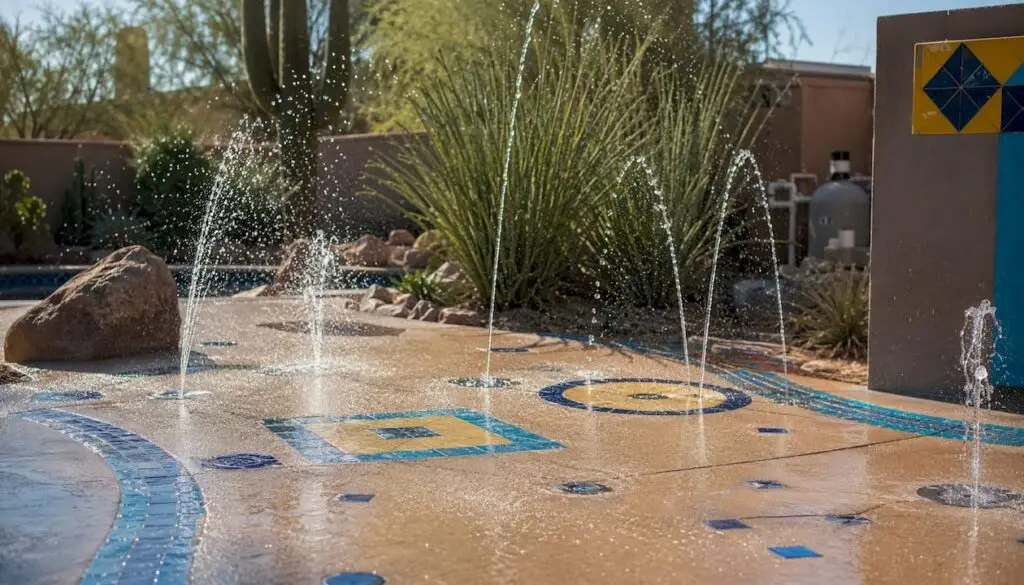
Yes, you can add a private backyard splash pad to most Phoenix yards, and for homeowners who already have a pool, integrating one through a remodel is usually the smarter path. Building a standalone splash deck from scratch is an option, but retrofitting Baja shelves, deck jets, or a dedicated wet-play surface into an existing pool project saves on excavation, permitting, and equipment costs. Here is how to move forward:
- Measure and define goals. Document your yard dimensions, existing pool footprint, and how your family will use the space (toddlers, older kids, adult lounging).
- Set a realistic budget range. Factor in surface, plumbing, equipment, drainage, and a contingency of 10–20%.
- Schedule a contractor consult and permit check. Phoenix-area permits and HOA reviews can add weeks; start that conversation early.
Pro Tip: Before you finalize any design, check your yard’s natural drainage slope and confirm your HOA’s water-feature rules. Phoenix HOAs and the City of Phoenix both regulate water features, and a slope that drains toward the house foundation will cost you significantly more to correct mid-project.
Key Takeaways
For most Phoenix homeowners, integrating a splash pad into an existing pool remodel is the fastest, most cost-effective path to a private backyard water-play feature.
| Point | Details |
|---|---|
| Remodel first | Integrating splash features into an existing pool remodel saves on excavation, permits, and equipment costs. |
| Budget realistically | Baja shelf retrofits typically run $8,000–$15,000; standalone splash decks often reach $20,000–$45,000 or more. |
| Plan for permits | Phoenix-area permits can take 4–8 weeks; start the contractor conversation before you finalize your design. |
| Prioritize drainage and surface | Slope, drain rate, and anti-slip finish are the decisions that most affect safety and long-term cost. |
| Wefixuglypools | Offers full-scope remodel services in Greater Phoenix, covering design, permits, construction, and written warranties. |
Table of Contents
- What splash pad options work best in Phoenix backyards?
- How much does a backyard splash pad cost in Phoenix?
- How long does a splash pad project take in Phoenix?
- What design and safety decisions should you lock down early?
- What equipment do you actually need for a splash pad system?
- Should you remodel your existing pool or build a splash pad from scratch?
- What does ongoing maintenance actually cost?
- What should you ask a contractor before signing anything?
- How Wefixuglypools approaches splash pad projects in Greater Phoenix
- What Phoenix homeowners usually don’t expect
- Wefixuglypools can handle your splash pad project from first visit to final inspection
- Sources
What splash pad options work best in Phoenix backyards?
Residential splash pads, also called splash decks or wet-play decks, come in several configurations. Each suits a different yard size, budget, and relationship to an existing pool.
- Standalone splash deck. A dedicated wet-play surface, typically 10×10 feet at minimum but often 200+ square feet for real playroom, with its own recirculating pump and nozzle array. Best for yards without a pool or where the pool is off-limits for young children.
- Baja shelf conversion. A wide, shallow ledge (usually 6–12 inches deep) added to or carved from an existing pool’s shallow end. Doubles as a splash zone and a tanning ledge. Low barrier to entry for families already remodeling.
- Integrated deck jets and pop jets. Nozzles installed in the pool deck that arc water into the pool or onto a wet-play zone. Lower cost than a full splash deck, minimal footprint, and easy to retrofit during a standard remodel.
- Small wet-play deck adjacent to pool. A poured-rubber or textured-concrete pad next to the pool, plumbed into the pool’s existing recirculation system. Ideal for families with toddlers who need a contained, shallow play area separate from the main pool.
| Approach | Design complexity | Upfront cost | Maintenance/water use |
|---|---|---|---|
| Standalone splash deck | Moderate–high | Moderate–high | Moderate (own system) |
| Baja shelf conversion | Low–moderate | Low–moderate | Low (shares pool system) |
| Deck jets/pop jets | Low | Low | Low |
| Adjacent wet-play deck | Moderate | Moderate | Moderate |
How much does a backyard splash pad cost in Phoenix?
Budget ranges vary widely depending on footprint, surface choice, and whether you are integrating into an existing pool or starting fresh. Here are realistic ballparks:
- Surface and finish: $8–$25 per square foot for textured concrete or pebble aggregate; $15–$40 per square foot for poured rubber or specialty coatings.
- Plumbing and equipment: $3,000–$10,000 for a recirculating pump, filtration, backflow prevention, and controller on a small-to-mid residential splash deck.
- Labor: $5,000–$15,000 depending on scope, site conditions, and whether demolition is required.
- Site prep and drainage: $1,500–$6,000; Phoenix’s caliche soil and flat lots often require engineered drainage solutions.
- Permits: $500–$2,000 depending on the city (Phoenix, Scottsdale, Chandler, and Surprise each have their own fee schedules).
Budget reality check: A basic Baja shelf retrofit integrated into an existing remodel can land in the $8,000–$15,000 range. A standalone splash deck with its own recirculating system typically runs $20,000–$45,000 or more for a well-finished residential installation.
Phoenix projects often face excavation challenges due to caliche rock and permit processing times that can extend timelines, both of which can increase costs.*
Pools around ten years old often need resurfacing at the same time, which makes bundling a splash feature into a full remodel the most cost-efficient timing.

How long does a splash pad project take in Phoenix?
A realistic timeline, phase by phase:
- Design and site measurement: 1–2 weeks. Contractor visits, drawings, and material selections.
- Engineering and permits: 3–8 weeks. Phoenix city permits and HOA approvals are the most common schedule variable.
- Demolition and site prep: 3–7 days for a retrofit; up to 3 weeks for a standalone installation with significant excavation.
- Plumbing and electrical rough-in: 1–2 weeks. Licensed plumbing work for drainage, backflow prevention, and recirculation connections is required in most Arizona jurisdictions.
- Surface finish and curing: 1–2 weeks. Concrete surfaces need full cure time before water exposure, especially in Phoenix summer heat.
- System testing and balancing: 3–5 days. Pump calibration, nozzle pressure, water chemistry baseline.
A fast-track Baja shelf integration during an existing remodel can finish in 6–10 weeks total. A complex standalone splash deck with new plumbing, drainage engineering, and custom finishes often runs 14–20 weeks, per contractor experience in the Phoenix market.
Schedule around heat. Concrete pours and surface finishes are best done outside of June–August peak heat. Many Phoenix contractors book spring and fall slots quickly; plan accordingly.
What design and safety decisions should you lock down early?
Surface choice and drainage slope are the two decisions that affect everything downstream. Get them wrong and you are dealing with slip injuries or standing water that breeds algae.
- Surface materials: Textured concrete (broom or exposed aggregate) offers durability and heat retention. Poured rubber is cooler underfoot and more forgiving for falls but costs more and degrades faster under Phoenix UV. Pebble finishes split the difference on cost and comfort.
- Slope and drainage: A minimum 1.5% slope away from structures is standard; 2% is better for Phoenix’s monsoon rain events. Every splash deck needs a dedicated drain, not a shared pool overflow.
- Edge treatment: Rounded coping edges and no abrupt level changes reduce injury risk for running children.
- Anti-slip finishes: Specify a minimum coefficient of friction (COF) of 0.6 wet for any horizontal surface. Ask your contractor for the product data sheet.
- Shade: Phoenix summer surface temperatures on unshaded concrete can exceed 150°F. Plan for a shade sail, pergola, or ramada over at least 50% of the play surface.
- Child safety: Fencing, self-latching gates, and immediate-drain nozzles (no standing water deeper than 1 inch) are the baseline. Confirm your contractor’s design meets Arizona’s residential pool barrier code (ARS §36-1681).
Pro Tip: Ask your contractor for 12×12-inch sample swatches of your top two surface finishes. Set them in your yard at noon in May and test them barefoot. What feels manageable in a showroom can be genuinely painful on a Phoenix summer afternoon.
Regular deck cleaning also preserves anti-slip texture over time; pressure washing removes the algae and mineral deposits that make wet surfaces dangerous.

What equipment do you actually need for a splash pad system?
The core equipment list for a residential splash deck:
- Variable-speed pump: Required for recirculating systems and significantly more energy-efficient than single-speed models. A common remodel upgrade that pays back in lower electricity bills.
- Filtration: Cartridge or sand filter sized to the splash deck’s water volume. Undersized filters are the most common spec mistake on small installations.
- Controller and timer: Programmable controllers let you run the splash feature during peak hours and shut it off automatically. Smart controllers with app access are worth the modest premium.
- Chemical feeder or automation: Inline chlorine feeders or salt-chlorine generators keep water chemistry stable without daily manual dosing.
- Backflow prevention: Required by code for any potable water connection. Licensed plumbing work is required for these connections in most Arizona jurisdictions.
Recirculation vs. continuous flow: A closed-loop recirculating system reuses the same water, which is the right choice for Phoenix given the city’s water restrictions and tiered pricing. Continuous-flow designs that drain to waste are rarely approved for residential use in Maricopa County under current conservation guidelines.
| Equipment item | Why it matters | Water/energy impact |
|---|---|---|
| Variable-speed pump | Cuts energy use vs. single-speed | High savings |
| Programmable controller | Limits run hours | Moderate savings |
| Efficient nozzles | Reduces flow rate without reducing play | Moderate savings |
| Inline chemical feeder | Maintains chemistry automatically | Reduces water waste from rebalancing |
Should you remodel your existing pool or build a splash pad from scratch?
For most Phoenix homeowners, remodeling an existing pool to integrate splash features is the more practical and cost-effective path. Local contractors consistently make this recommendation, and the math usually supports it: you share excavation, plumbing, and equipment costs across the full project rather than duplicating them.
When remodeling makes the most sense: Your pool is 10+ years old and the finish is deteriorating. Equipment is single-speed or undersized. You want a Baja shelf or deck jets added to an existing shallow end. Your yard has limited space for a separate structure. You want to complete the project in one permitted scope of work.
Use this checklist to decide:
- Pool age and finish condition: Pools needing resurfacing are prime candidates for a simultaneous splash feature integration.
- Existing plumbing and equipment: If the pump and filter are already due for replacement, a remodel bundles those costs efficiently.
- Desired footprint: A large standalone splash deck (200+ sq ft) with its own system may warrant a separate installation if the existing pool layout cannot accommodate it.
- Structural constraints: Older pools with gunite cracks or failing bond beams need structural repair before any feature addition.
- Budget sensitivity: Remodels typically cost less than new construction for equivalent water-play outcomes.
What does ongoing maintenance actually cost?
| Task | Frequency | Phoenix-specific note |
|---|---|---|
| Water chemistry check | Daily/every 2 days | Higher evaporation raises chemical demand |
| Filter rinse or backwash | Weekly | Dust and caliche debris clog filters faster |
| Nozzle and drain inspection | Monthly | Mineral deposits from hard Phoenix water |
| Deck surface cleaning | Monthly | UV and heat accelerate algae and scale buildup |
| Full equipment service | Annually | Check seals, impellers, and controller calibration |
| Winterization | Not required in Phoenix | Freeze protection is minimal; off-season shutdown optional |
Annual operating costs for a mid-size residential splash deck in Phoenix include chemicals, electricity for the pump, and routine service, varying with usage and local rates. Water costs depend on your municipality’s tiered pricing and how often you top off for evaporation loss, which is significant in Phoenix’s dry heat. Phoenix Water Services and most Valley municipalities publish current tiered rate schedules; check your rate tier before finalizing the system design.
What should you ask a contractor before signing anything?
Questions to ask every bidder:
- Are you licensed with the Arizona Registrar of Contractors (ROC)? Can I verify your ROC number?
- Do you carry general liability and workers’ compensation insurance?
- Have you pulled permits in my specific city (Phoenix, Scottsdale, Chandler, etc.) for splash deck or pool remodel work?
- Can you provide three local references with contact information for projects similar to mine?
- What warranty do you offer on workmanship and on equipment?
Deliverables to require in writing:
- Written scope of work with material specs (surface product, pump model, filter size).
- Permit responsibility clearly assigned to the contractor.
- Milestone payment schedule tied to project phases, not arbitrary dates.
- Change-order pricing method stated upfront.
- Warranty terms in writing, covering both labor and equipment.
Vetting your contractor carefully before signing protects your budget and your timeline.
How Wefixuglypools approaches splash pad projects in Greater Phoenix
Wefixuglypools has spent over a decade completing hundreds of pool remodels and custom builds across the Greater Phoenix area, from Baja shelf conversions in Scottsdale to integrated splash decks in Surprise and Chandler. The process is structured to protect homeowners at every step.
- Site visit and design: A licensed team member visits your property, documents existing conditions, and develops a written scope before any design work begins.
- Permitting: Wefixuglypools handles permit applications and city coordination, including HOA submittals where required.
- Construction milestones: Projects follow a phased schedule with clear milestones, so you always know what is happening and when.
- Commissioning and warranty: Every project closes with a system test, water chemistry baseline, and a written warranty covering workmanship and installed equipment.
What homeowners consistently find: Bundling a Baja shelf or splash deck into a full remodel, rather than treating it as a separate project, compresses the timeline and reduces total cost. Wefixuglypools’s pool remodeling services are built around exactly that approach, with feature integration, equipment upgrades, and resurfacing handled as a single coordinated scope.
The company’s portfolio includes high-visibility projects that demonstrate project management at scale, alongside the residential remodels that make up the core of their Phoenix-area work.
What Phoenix homeowners usually don’t expect
Most homeowners walk into a splash pad project focused on the fun part: nozzle layouts, surface colors, and shade structures. The surprises almost always come from the ground up.
Drainage is the one that catches people most often. Phoenix lots are frequently flat by design, and the caliche layer just below the surface resists excavation and drainage installation in ways that add both time and cost. The second surprise is permit timing. City of Phoenix building permits for pool features can take four to eight weeks, and HOA architectural reviews run on their own schedule entirely. The third is surface temperature. Homeowners who choose a beautiful exposed aggregate finish in a showroom sometimes discover it holds heat aggressively in July. Testing sample swatches in real Phoenix midday conditions, not just in a contractor’s office, is the single most practical thing you can do before committing.
Before your first consult, take a photo of your electrical panel (contractors need to know available amperage for pump upgrades), walk your yard after a monsoon rain and note where water pools, and check for any prior patch repairs on the pool shell. Those three observations will make your first contractor conversation significantly more productive.
Wefixuglypools can handle your splash pad project from first visit to final inspection
Wefixuglypools gives Phoenix homeowners a single point of contact for the entire project: site assessment, design, permits, construction, and warranty. No chasing subcontractors, no permit confusion, no surprise scope gaps.

What you get from an initial consult:
- A licensed site assessment covering your existing pool condition, drainage, and electrical capacity.
- A written budget range and timeline estimate before any commitment.
- Clear permit responsibilities and HOA coordination included in the scope.
Ready to see what your backyard could look like? Request a remodel consult with Wefixuglypools and get a written scope, not just a ballpark number.
Sources
- Ktar


