
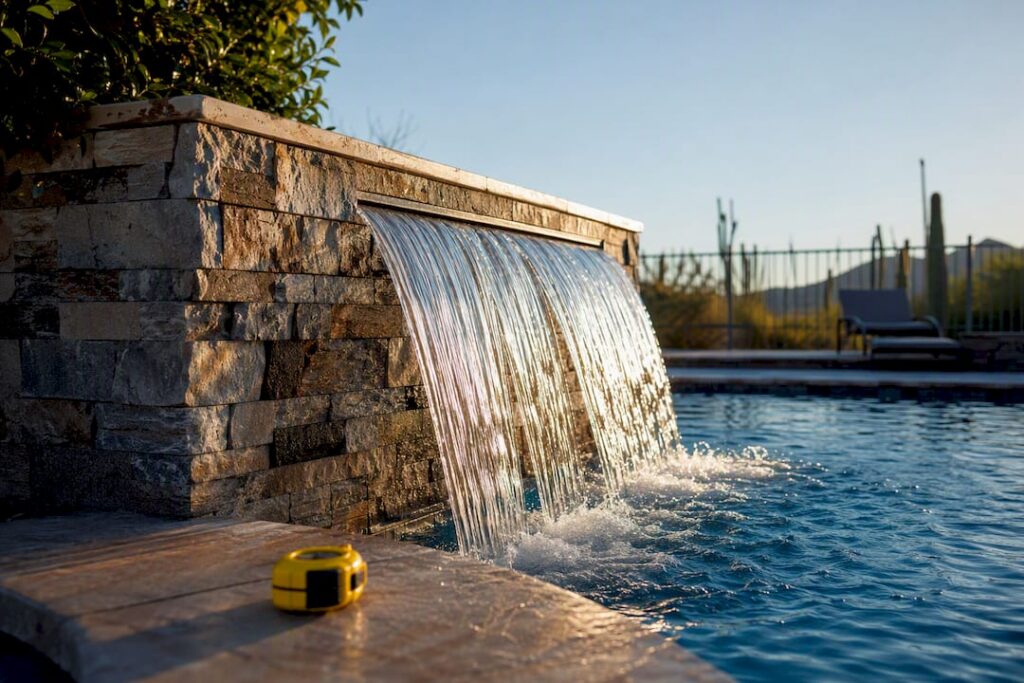
Sheer descent panels, spillover spas, laminar jets, and cast rock waterfalls stand out as the most popular pool waterfall ideas homeowners request today, and they aren’t equally easy to add after the fact. Deck jets and laminar jets retrofit into an existing pool with minimal disruption, while a full rock grotto usually means opening up the shell. Below, we break down each style, what it costs to add, and how to plan the design so it actually looks intentional.
TL;DR:
- Retrofit options like deck jets and laminar jets are quick to install, often completed in a day or two, with minimal disturbance to existing pools.
- Larger, structural waterfalls such as grottos or sheer descent walls may require extensive modifications, taking several weeks and increasing costs significantly.
- Pump sizing directly impacts waterfall performance, with undersized pumps producing weak sheets and the need for precise calculations to avoid underperformance.
- Costs vary from a few thousand dollars for small accents to well beyond that for large naturalistic or sheer descent features, depending on materials and structural demands.
- Proper lighting, coloration, and placement integration are essential for the waterfall to enhance the pool aesthetic, especially when considering nighttime effects.
Table of Contents
- Pool Waterfall Ideas Worth Considering for Your Backyard
- Design and Materials That Make a Waterfall Read Well
- Can You Retrofit a Waterfall Into an Existing Pool?
- Sizing, Cost, and What Maintenance Actually Looks Like
- How to Choose the Right Waterfall and Vet a Contractor’s Bid
- Three Ways the Same Idea Can Look Completely Different
- What a Decade of Pool Remodels Taught Us About Waterfalls
- Ready to Add a Waterfall Your Pool Actually Deserves?
- Sources
- FAQ
Pool Waterfall Ideas Worth Considering for Your Backyard
Before hiring anyone, it helps to know what you’re actually choosing between. Each waterfall style has a distinct look, a different plumbing demand, and its own retrofit difficulty.
- Sheer descent / sheer rain. This is the glassy, unbroken sheet of water that clings to a wall before dropping cleanly into the pool. It’s the defining feature of modern pool waterfall designs. Units run from 1 foot to 8 feet wide with lip sizes of 1, 6, or 12 inches, and they need roughly 5 to 15 gallons per minute of flow for every foot of width, which is why pump sizing matters so much here. Best for: contemporary and minimalist backyards. Pros: clean lines, quiet operation, striking at night. Con: an unlevel lip breaks the sheet into visible gaps.
- Natural rock waterfall / grotto. Built from real boulders, gunite, or GFRC shells, this style carries visual weight and often includes a cave or seating area behind the falling water. Best for: tropical or resort-style yards. Pros: the most dramatic sound and scale, blends into desert or lush landscaping. Con: heaviest structural demands and highest disruption of any option.
- Spillover spa. A raised spa set 12 to 24 inches above the waterline creates a continuous waterfall using only the spa’s own return plumbing. Best for: anyone already planning a raised spa. Pros: no separate feature to plumb, doubles as a hot tub. Con: less design flexibility in shape and placement.
- Laminar jets and deck jets. These shoot a smooth, glass-like arc of water that’s virtually silent and takes LED color exceptionally well. Best for: evening entertaining and modern pool waterfall styles. Pros: easiest of all styles to retrofit, low water volume. Con: higher per-unit cost than a basic sheer panel.
- Scuppers, spouts, and water bowls. Small, budget-friendly accents that pour a modest stream from a raised wall or bowl. Best for: subtle background sound without a major visual centerpiece. Pros: inexpensive, easy to place almost anywhere. Con: minimal visual drama on their own.
Design and Materials That Make a Waterfall Read Well
Finish color changes everything about how a sheer descent looks. A dark tile or plaster wall makes the glass sheet pop with contrast, while lighter finishes soften and mute the effect, which matters when you’re picking materials for pool landscaping around the feature.
Placement matters just as much as material. Keep sightlines from the main patio or kitchen window clear, and integrate coping, benches, or steps so the water feature doesn’t look bolted onto the pool. A long, low stone wall with a narrow veil of falling water tends to anchor the whole composition better than a tall, narrow one.
- Backlight sheer descent blades from behind for a glowing edge effect at night.
- Use underwater LEDs directly beneath laminar jets so the entire water column carries color.
- Uplight rock features from below to add depth and shadow without harsh glare.
- Choose textured, slip-resistant caps for any natural stone your family will walk near.
Pro Tip: If you want your waterfall to feel custom rather than catalog, ask your contractor to recess the plumbing niches and light housings into the stone or wall, following the same technical detailing that keeps high-end sheer descent walls looking seamless.
Explore more pool lighting design options if you’re weighing how much drama you want after dark.

Can You Retrofit a Waterfall Into an Existing Pool?
Yes, in most cases, and the difficulty scales directly with the size of the feature.
- Easy retrofits: deck jets, laminar jets, and small scuppers need only a hole in the deck and a tie-in to existing return lines. Disruption is minimal and often finishes in a day or two.
- Moderate retrofits: a bottom-fed or backfed sheer descent panel usually requires building a raised wall and tying new plumbing into the equipment pad.
- Complex retrofits: a grotto or large natural rock structure often means modifying the pool shell or adding engineered supports, since these designs carry real structural weight.
Cast rock systems like RicoRock kits simplify this last category considerably. They’re molded and lighter than real boulders, which cuts down on structural load and shortens installation time. Expect a dedicated pump or new electrical circuit any time lighting or a second feature gets added.
Sizing, Cost, and What Maintenance Actually Looks Like
Costs vary enormously by scale and material. A modest natural rock waterfall retrofit can start in the low thousands, while larger boulder or grotto builds climb well beyond that as structural work and stone volume increase. Deck jets and small blades sit at the affordable end; full sheer descent walls and grottos anchor the higher end.
- Run large features on a timer or a dedicated variable-speed pump to control energy use.
- Clear debris regularly, since rock pockets and grotto crevices trap leaves and grow algae faster than open water.
- Plan to winterize jets in freeze-prone climates and budget for periodic LED replacement.
- Ask any contractor for a line-item estimate covering pump, plumbing, stonework, electrical, and lighting separately.
Pro Tip: A vague, all-in number is a red flag. A contractor who breaks out pump sizing and plumbing costs separately is one who has actually engineered the flow, not just eyeballed it.
How to Choose the Right Waterfall and Vet a Contractor’s Bid
Start with sound preference, style fit, budget, and how much retrofit disruption you can tolerate. A quiet laminar jet suits a small courtyard pool; a rock grotto suits a large lot where sound and scale matter more than easy installation.
When you’re comparing bids, ask these questions before signing anything:
- What GPM and head loss did you calculate for this specific feature?
- Is the feed type backfeed or bottomfeed, and why did you choose it?
- What structural support does the design need, and how is it waterproofed?
- How does the lighting tie into the existing pool circuit?
- What warranty covers the pump, plumbing, and finish separately?
- Confirm the contractor discussed permits, not just design.
- Walk away from any bid missing pump specs entirely.
- Get the plumbing plan in writing, not just a verbal description.
Three Ways the Same Idea Can Look Completely Different
- Modern linear: a long, narrow sheer descent panel set against dark tile, paired with floating concrete steps. The straight lines echo the home’s architecture and keep the whole yard feeling calm rather than busy.
- Natural resort: a boulder waterfall with dense planting and a small grotto seating nook behind the falling water. This trades some quiet for real presence. The sound carries, and the visual weight anchors the whole backyard.
- Retrofit minimal: a run of deck jets alongside one small sheer blade, all lit with colored LED jets. Almost no structural work, yet the evening effect rivals a much larger build.
What a Decade of Pool Remodels Taught Us About Waterfalls
Homeowners consistently underestimate two things: how much pump sizing affects the final look, and how disruptive a large rock feature really is compared with jets or a small blade. A deck jet retrofit can wrap up in a few days. A grotto or full sheer descent wall tied into new plumbing often runs several weeks once structural work and electrical are involved.
We’ve walked plenty of backyards where the original waterfall was undersized for the pump it was given, leaving a weak trickle instead of the sheet the owner pictured.
— Brian
Ready to Add a Waterfall Your Pool Actually Deserves?
One local alternative is to use a single contractor who can handle design, plumbing, electrical, and lighting integration under one contract for waterfall projects, whether a sheer descent wall, cast rock grotto, or deck jets.

We build custom pool features as part of full remodels and new construction across the Greater Phoenix area, and our water features page shows the range of waterfalls, fountains, and grottos we install. If your existing pool needs plumbing or structural work before a waterfall goes in, our pool repair services team handles that too. Schedule an on-site consultation and get a real, line-item quote before you commit to a design.
Sources
For manufacturer specs, the Jandy Sheer Descent guide covers widths, lip sizes, and flow requirements in detail. RicoRock’s cast-rock reference explains the structural tradeoffs versus real boulders. For composition inspiration, see our guide to types of pool water features and backyard pool and landscape ideas.
- Jandy Sheer Descent & Sheer Rain water features – comprehensive guide
- Pool waterfall ideas: the best alternative to natural rock – RicoRock
- Pool Waterfall Design Visualizer | Design Your Swimming Pool Waterfall
- Infinity pool with waterfall in natural stone
FAQ
Can I Add a Waterfall to My Existing Pool?
Yes, most existing pools can accept a waterfall without rebuilding the whole shell. Deck jets, laminar jets, and small scuppers are the easiest additions, while a natural rock grotto usually requires shell modification or engineered support.
How Do You Build a DIY Pool Waterfall?
A true DIY build works best for small accents like a scupper or spout, since those need only basic plumbing skills and a tie-in to an existing return line. Sheer descent panels and rock waterfalls involve pump sizing, head loss calculations, and often electrical work, which is why most homeowners bring in a licensed pool contractor for those styles.
What Is the Best Waterfall Type for an Inground Pool?
There’s no single best type. It depends on your style and budget: sheer descent suits modern pools, laminar jets suit anyone wanting quiet, colorful evening drama, and natural rock or RicoRock suits a resort look.
How Much Does It Cost to Add a Waterfall to an Existing Pool?
Costs range widely by style and scale. A modest natural rock waterfall retrofit can start in the low thousands, while larger rock builds or full sheer descent walls cost considerably more once plumbing, structural work, and lighting are factored in. Wefixuglypools provides itemized quotes after an on-site evaluation through our custom pools service.
Do Pool Waterfalls Use a Lot of Water or Electricity?
Waterfalls do increase pump run time, but running the feature on a timer or a dedicated variable-speed pump keeps energy use in check. Laminar jets in particular use less water volume than sheer descent blades, which helps if conservation is a priority.


