If your pool is losing more water than typical evaporation suggests you may have a leak, not just summer heat. The fastest way to confirm it: shut off your autofill valve and run a bucket test tonight. If the pool drops faster than the bucket, you’ve found your answer. From there, a pump on/off test and a little detective work around the equipment pad will tell you whether you’re chasing a plumbing leak or a shell problem.
TL;DR:
- Running a bucket test without autofill and comparing the water level after 24 hours confirms if a leak exists beyond normal evaporation.
- Water loss that continues after the bucket test suggests a shell crack, buried pipe, or structural issue requiring professional diagnosis.
- A pump on/off test and dye test help locate whether the leak is on the pressure side, suction side, or within the pool shell.
- Visual cues like soggy soil, sunken pavers, cracks, or bubbling return jets indicate specific leak locations, guiding repair priorities.
- Immediate actions, such as turning off the autofill, documenting water levels, and avoiding electrical hazards, can limit damage before professional help is needed.
Think your pool is leaking? See our pool leak detection & repair service »
Table of Contents
- What Are the Signs of a Pool Leak?
- How Do You Confirm a Leak Yourself?
- Where Is the Leak Actually Coming From?
- When Should You Call a Pool Repair Professional?
- What Should You Do Right Now to Limit Damage?
- What We See Most Often in the Field
- Why Most Leak Advice Stops Too Early
- Get a Straight Answer on Your Leak
- Sources
- FAQ
What Are the Signs of a Pool Leak?
Not every drop in water level means trouble. Evaporation alone can account for some water loss per day depending on your climate, wind, and pool surface temperature, according to Denver Water’s conservation guidance. Anything beyond that, especially if it’s consistent day after day, points toward a real leak rather than the sun doing its job.
Here’s what tends to show up first, and what each pool leak symptom usually means:
- Water loss faster than evaporation — losing water faster than usual with autofill off is a clear warning sign.
- Soggy ground, sunken pavers, or a suddenly greener patch of lawn near the pool shell or equipment pad, which often signals a buried plumbing leak.
- Cracks, loose tile, or a liner that’s pulling away at the skimmer or light niche, a classic shell-leak sign.
- The pump losing prime repeatedly or air bubbles spitting out of the return jets, both suggesting a suction-side issue pulling in air instead of water.
- A water bill that jumped without an obvious reason, or an autofill valve that’s running more than it used to.
- Chemistry that won’t hold — chronic stabilizer loss or algae blooms despite normal chemical dosing, since leaking water carries dissolved chemicals out with it.
One detail catches most homeowners off guard: automatic fill valves are designed to mask this exact problem. City of Mesa’s water conservation office estimates up to 30% of pools may have a leak at any given time, and autofill systems keep topping off the water level so quietly that owners never notice until the utility bill arrives. If your pool “never seems to lose water,” that is not necessarily good news. It might just mean your autofill valve is doing the worrying for you.
How Do You Confirm a Leak Yourself?
Three tests will tell you almost everything you need to know before you ever pick up the phone. Run them in this order.
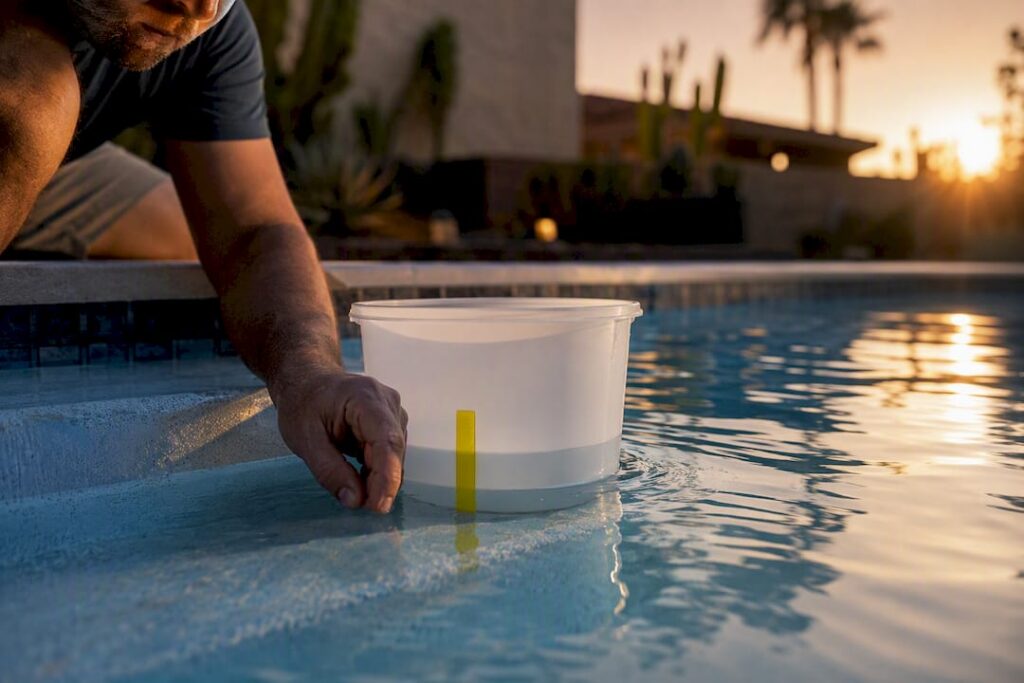
- Bucket test. Turn off the autofill valve. Place a straight-sided bucket on the second step of the pool, fill it with water to match the pool’s level, and mark both water lines with tape or a marker. Wait 24 hours, then compare. If the pool level dropped more than the bucket’s, you’re losing water to something beyond evaporation, confirming a leak rather than normal water loss.
- Pump on/off test. Run the pump for a full 24 hours and mark the water level, then shut it off for another 24 hours and mark again. If the pool loses more water with the pump running, the leak sits somewhere in the pressure-side plumbing. If it loses more with the pump off, you’re likely looking at a suction-side or shell leak, according to InspectAPedia’s plumbing leak analysis.
- Dye test. Once the water is still, no filtration, no wind ripples, draw a small amount of dye into a syringe or turkey baster and release it slowly near a suspected crack, fitting, or skimmer throat. Colored water pulled steadily toward one spot confirms a shell or fitting leak. Dye tests don’t work on buried pipe leaks, since there’s no visible opening for the water to funnel into.
Pro Tip: Run these tests on a calm evening. Wind ripples and daytime evaporation both skew your bucket-test numbers, and a windy pool surface will scatter dye before you ever see a pull pattern.
Where Is the Leak Actually Coming From?
Your test results narrow things down fast if you read them the right way. The “where it stops” rule is the simplest trick in the book: if water loss stops once the level drops to the skimmer opening or the light niche, the leak sits right at that fixture. If it keeps falling below that point, you’re dealing with something lower, often a main drain line or buried pipe.
A few visual cues back this up:
- Wet or spongy soil near the equipment pad usually traces back to a cracked pressure-side pipe.
- Hollow-sounding or sunken pavers around the deck often mean water has been undermining the base for a while.
- Bubbles at the return jets during pump operation point to a suction-side leak pulling air into the system.
- Persistent staining or cracking at the skimmer housing or light fixture usually means the leak is right there, not somewhere downstream.
When Should You Call a Pool Repair Professional?
DIY testing has its limits, and pushing past them usually costs more than it saves. Call a professional when water loss continues after you’ve ruled out evaporation, when you suspect a buried pipe, or when you see structural cracks near electrical conduit. Any leak close to pool lighting or bonding wire is a safety issue first, a leak second.
Professionals typically escalate through:
- Line-by-line pressure testing to isolate exactly which run of plumbing is failing.
- Acoustic or hydrophone equipment that listens for the sound of escaping water underground, letting technicians pinpoint a leak within a foot or two.
- Video inspection of accessible lines when the leak’s exact location still isn’t clear.
- Targeted excavation only after the location is confirmed, not as a guessing exercise.
This targeted approach is precisely why hiring a pro often ends up cheaper than the alternative. Acoustic detection lets technicians dig in one specific spot instead of trenching an entire yard hunting for a pipe. Diagnostic fees, repair complexity, and how deep the plumbing runs all factor into the final bill, and a technician holding a Certified Pool & Spa Operator credential is a reasonable baseline to look for when vetting who you hire.
What Should You Do Right Now to Limit Damage?
While you’re diagnosing or waiting on a callback, a few immediate moves protect your pool and your yard. Turn off the autofill valve so you can actually see how much water you’re losing. Take dated photos of the water line, any cracks, and your water meter reading. If water is pooling anywhere near electrical conduit or the equipment pad’s wiring, shut off power at the breaker and call an electrician before you touch anything else, an important caution echoed in general pool safety and insurance guidance.

For genuinely minor issues, a vinyl patch kit or a re-tightened fitting can hold you over. For anything involving the shell or wall structure, our guide on repairing leaking pool walls walks through what’s realistically a weekend fix versus what isn’t.
Pro Tip: Keep a simple log: date, water meter reading, and photo. If you end up filing an insurance claim or hiring a contractor, that log turns a vague complaint into documented evidence.
What We See Most Often in the Field
After a decade of remodeling and repairing pools across the Phoenix area, one pattern shows up constantly: homeowners run a bucket test, find nothing conclusive, and assume they’re in the clear. Often the real culprit is a slow structural crack or a failing skimmer seal that hides from a single overnight test. Sort urgent from non-urgent by asking one question: is water reaching wiring or undermining the deck? If yes, don’t wait on it.
Why Most Leak Advice Stops Too Early

Most guides treat the bucket test as the finish line. It isn’t. It tells you whether you have a leak, not where it is or how bad the underlying problem might be. The gap that trips up most homeowners is assuming a passed pump on/off test means the leak is minor. A slow shell crack behaves the same as a small evaporation difference for weeks before it becomes an expensive structural repair.
Here’s the judgment worth acting on: if your bucket test confirms water loss beyond evaporation, don’t cycle through weeks of guesswork. Run the pump on/off test and dye test within the same week, then decide. A leak that’s still unexplained after both tests almost always means buried plumbing or a hidden structural issue, and that’s not a DIY afternoon anymore. The homeowners who save the most money are the ones who stop testing and start calling at the right moment, not the ones who wait for the problem to get undeniable.
— Brian
Get a Straight Answer on Your Leak
Some pool service companies specialize in fixing pools that other contractors have missed or worsened, with leak detection often highlighting their expertise. Instead of guessing at cracks or trenching your whole yard, our technicians use pressure testing and targeted diagnostics to find the actual source before any repair work starts.

A typical inspection visit includes reviewing your bucket and pump test results if you’ve already run them, checking the equipment pad and plumbing runs, and pressure testing isolated lines to confirm exactly where the leak sits. From there, we handle everything from plumbing repair to full resurfacing if the shell has taken damage. If you’ve confirmed water loss beyond evaporation and want a real answer instead of another guess, reach out through our pool repair services page to schedule an inspection.
Sources
- City of Mesa — Pool leaks
- FloPool — How to detect a pool leak before you pay for detection
- InspectAPedia — Swimming pool leak detection
- Aiper — Is your pool leaking? How to find it in 3 tests
FAQ
How Can You Tell if Your Pool Is Leaking Water?
Run a bucket test with autofill off; if the pool drops faster than the marked bucket over 24 hours, you’re losing water beyond normal evaporation.
Why Is My Pool Losing an Inch of Water a Day?
That rate is well beyond typical evaporation loss and usually points to a leak in the shell, a fitting, or buried plumbing, especially if it happens consistently regardless of weather.
How Expensive Is It to Fix a Pool Leak?
Cost depends on diagnostic complexity and how deep the affected plumbing runs, so get a firm quote after inspection. Wefixuglypools doesn’t publish flat repair pricing online, but current estimates are available through our pool repair page.
What Is the Most Common Cause of Pool Leaks?
Skimmer and fitting failures at the shell are among the most frequent culprits, alongside cracked pressure-side plumbing near the equipment pad.