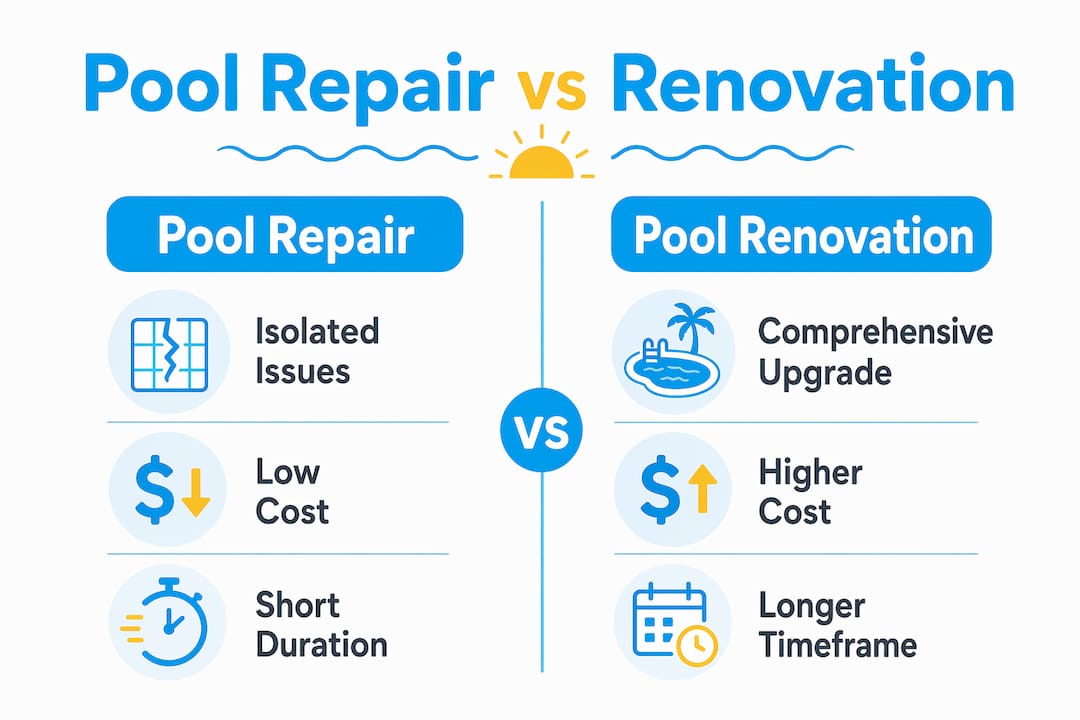
Pool repair fixes specific, isolated problems to restore function, while pool renovation is a comprehensive process that modernizes and upgrades the entire pool system. Understanding the pool renovation vs repair difference saves homeowners from spending thousands on repeated patch jobs when a full upgrade would cost less over time. The two terms get used interchangeably, but they describe fundamentally different scopes of work, timelines, and budgets. Getting this distinction right is the first step toward making a sound financial decision for your home.
What is the pool renovation vs repair difference?
Pool repair addresses a single, contained failure. Think of a cracked return fitting, a leaking pump seal, or a broken tile. Minor repairs range from $150 for small cracks to $2,500 for mid-range equipment fixes. The goal is to restore one component to working order without touching anything else.
Pool renovation, by contrast, is a whole-system upgrade. It typically includes resurfacing, equipment replacement, deck work, and sometimes structural changes like reshaping the pool or adding features. Renovation costs generally run $15,000 to $75,000 depending on scope. That price reflects weeks of skilled labor, permits, and materials across multiple systems at once.
Pool restoration is a third term worth clarifying. Restoration returns a pool to its original condition without changing its layout or structure. Renovation can include structural alterations like changing pool shape, depth, or adding modern features such as tanning ledges. Knowing which category your project falls into helps you get accurate quotes and set realistic expectations.
How do scope and cost compare between repair and renovation?
The clearest way to separate repair from renovation is by scale. A repair takes days. A full renovation takes 2–6 weeks. New pool construction, for comparison, runs 3–6 months including permitting. That timeline gap reflects the difference in complexity and coordination required.
Here is a direct cost and scope comparison:
| Category | Typical Cost | Duration | Scope |
|---|---|---|---|
| Minor repair | $150–$500 | 1–2 days | Single component fix |
| Mid-range repair | $500–$2,500 | 2–5 days | Equipment or plumbing fix |
| Major structural repair | $5,000–$15,000 | 1–2 weeks | Resurfacing or structural patch |
| Full renovation | $15,000–$75,000 | 2–6 weeks | Multi-system upgrade |
| New construction | $50,000+ | 3–6 months | Complete build with permits |
Common repair tasks include:
- Patching a single crack in the shell
- Replacing a failed pump or filter
- Fixing a broken or loose tile
- Sealing a plumbing leak
Common renovation tasks include:
- Full resurfacing with new plaster, pebble, or quartz finish
- Upgrading to variable-speed pumps and LED lighting
- Rebuilding or extending the pool deck
- Changing pool shape or adding a tanning ledge
When repair costs approach 30–50% of renovation costs, renovation becomes the financially wiser choice. That threshold is a practical rule of thumb, not a hard law, but it holds up consistently across real projects.
How to assess your pool’s condition before deciding
The age and surface condition of your pool are the two most reliable starting points. Pools over 10 years old with widespread staining, etching, or cracking are candidates for full resurfacing rather than localized repair. Pools under 8 years old with a single failure are almost always better served by a targeted fix.
Signs your pool needs renovation:
- Surface feels rough or shows widespread staining across multiple areas
- You have scheduled three or more separate repairs in the past 12 months
- Equipment runs inefficiently and drives up your utility bills
- The pool’s appearance has become a liability rather than an asset
Signs a repair is the right call:
- The problem is isolated to one component or area
- The pool surface is in good overall condition
- The pool is relatively new or recently resurfaced
- The repair cost is well below 30% of what a renovation would run
Pro Tip: Track every repair invoice in a simple spreadsheet. If your total repair spending over 24 months is creeping toward half the cost of a renovation, that data makes the decision obvious. You are no longer fixing a pool. You are funding a slow, expensive decline.
The concept of cumulative financial burden is what most homeowners miss. Each repair feels manageable in isolation. But repeated repairs increase overall lifetime costs and utility bills, making renovation the more economical long-term choice. Seeing the full picture changes the math entirely.
What are the most common pool repair options?
Pool repairs fall into a few well-defined categories, each suited to a specific type of failure. Understanding what each repair covers, and what it cannot fix, helps you avoid paying for work that will not solve the underlying problem.
Common repair types and their appropriate use:
- Crack patching: Suitable for hairline or isolated structural cracks. Costs $150–$800 depending on size and access. Not effective for widespread shell deterioration.
- Plumbing leak repair: Addresses broken or corroded pipes, fittings, or valves. Costs $200–$1,500. Repeated leaks in multiple locations signal a systemic issue.
- Pump and filter replacement: Replaces a failed motor, pump basket, or filter unit. Costs $500–$2,000. A good repair when the rest of the equipment is sound.
- Tile repair: Fixes loose, cracked, or missing tiles. Costs $150–$600 for small sections. Widespread tile failure across the waterline usually points to a renovation need.
- Resurfacing a section: Patches a localized area of failing plaster. Costs $1,000–$3,000. Color and texture rarely match perfectly, which is why full resurfacing is often the better call aesthetically.
Pro Tip: Ask your pool technician whether the repair addresses the root cause or just the symptom. A pump that fails repeatedly may signal undersized plumbing or a clogged return system. Fixing the pump alone without addressing the cause leads to another failure within months.
For a deeper look at what professional repair actually involves, the pool repair process covers the key conditions that separate a good repair from a wasted expense. The right repair, done correctly, extends a pool’s life. The wrong repair, done repeatedly, drains your budget without improving your pool.
What does pool renovation involve and what benefits does it provide?
A pool renovation is a coordinated upgrade across multiple systems at once. It goes well beyond fixing what is broken. The goal is to bring the entire pool up to current standards in appearance, efficiency, and safety. A complete renovation typically includes resurfacing, equipment upgrades, deck repair, and sometimes layout redesign.
Typical renovation activities include:
- Resurfacing: Applying a new plaster, pebble, or quartz finish over the existing shell
- Equipment upgrades: Installing variable-speed pumps, saltwater systems, or automated controls
- Deck work: Repairing, resurfacing, or replacing the surrounding deck material
- Structural changes: Altering pool shape, depth, or adding features like tanning ledges or water features
- Lighting: Upgrading to LED systems for energy savings and visual impact
The benefits extend well beyond aesthetics. A well-executed renovation signals home value and desirability to buyers, improving resale prospects compared to a pool with frequent patch repairs or visible aging. Modern equipment also runs more efficiently, which cuts monthly utility costs. For homeowners planning to sell within five years, a renovation is often a direct investment in sale price.
The pool renovation process typically runs 2–6 weeks from start to finish. Structural changes that require permits add time, so planning ahead matters. Wefixuglypools recommends scheduling renovations in the fall or early spring in the Phoenix area to avoid peak demand and summer heat delays.
Understanding the pool renovation vs new construction comparison is also worth your time if your existing structure is severely compromised. Renovation costs a fraction of new construction in most cases, but when the shell is beyond repair, building new can be the smarter long-term investment.
Key Takeaways
The pool renovation vs repair difference comes down to scope: repair fixes one isolated problem, while renovation upgrades the entire pool system for lasting performance and value.
| Point | Details |
|---|---|
| Repair targets one failure | Use repair for isolated issues costing $150–$2,500 with a quick turnaround. |
| Renovation covers the whole system | Renovation costs $15,000–$75,000 and takes 2–6 weeks across multiple systems. |
| Age and frequency signal the right choice | Pools over 10 years old with three or more failures in 12 months need renovation. |
| Cumulative costs expose the real math | Repeated repair spending approaching 30–50% of renovation cost makes renovation smarter. |
| Renovation builds home value | Updated finishes and modern equipment improve resale appeal and reduce utility bills. |
What I have learned after years of watching homeowners choose wrong
The most common mistake I see is homeowners treating each repair as a standalone event. They call for a pump fix in march, a crack patch in june, and a tile repair in september. Each invoice looks reasonable. But when you add them up across 18 months, they have spent $4,000 on a pool that still looks tired, runs inefficiently, and will need the same repairs again next year.
The frequency of failures is the most honest signal I know. Three or more distinct system failures within 12 months strongly indicate the need for renovation rather than continued repairs. That is not a sales pitch. It is the point at which the pool has passed its reliable service life, and patching it is like replacing tires on a car with a cracked frame.
I also see homeowners underestimate the hidden costs. Repeated leak detection visits, inefficient old equipment running up electricity bills, and the time spent coordinating multiple service calls all carry real costs that never show up on a single invoice. Hidden costs like these accumulate fast and make a renovation that includes new equipment economically better than continued repairs.
My honest advice: get a professional inspection before you commit to either path. A good inspector will tell you whether the shell is structurally sound, whether the equipment has life left, and whether the surface damage is localized or systemic. That one conversation can save you from spending $3,000 on repairs that delay a $20,000 renovation by six months. Avoid the common renovation mistakes that come from skipping this step.
— Brian
How Wefixuglypools helps you make the right call
Wefixuglypools has spent over a decade transforming pools across the Greater Phoenix area, handling everything from targeted repairs to full-scale remodels. We know that the right answer is not always the same for every homeowner, and we take the time to assess your pool’s actual condition before recommending a path forward.
Whether you need a fast, reliable pool repair service or a complete pool remodeling project, our team provides transparent estimates and honest guidance from the first conversation. We have completed hundreds of transformations, and we bring that experience to every assessment. Contact Wefixuglypools today for a free evaluation and find out exactly what your pool needs.
FAQ
What is the main difference between pool repair and renovation?
Pool repair fixes a single, isolated failure such as a cracked fitting or broken pump. Pool renovation is a comprehensive upgrade covering resurfacing, equipment, and sometimes structural changes across the entire pool.
How much does pool repair cost compared to renovation?
Pool repairs typically cost $150–$2,500 for most common issues, while full renovations range from $15,000 to $75,000 depending on scope and materials.
How do I know if my pool needs renovation instead of repair?
If your pool is over 10 years old, shows widespread surface damage, or has needed three or more separate repairs within 12 months, renovation is the stronger choice financially and practically.
How long does a pool renovation take versus a repair?
Standard repairs complete within a few days. Full renovations typically take 2–6 weeks, while new pool construction runs 3–6 months including permitting.
Does pool renovation increase home value?
A well-executed renovation with updated finishes and modern equipment improves resale appeal and buyer perception. A pool with visible aging or repeated patch repairs can work against your home’s value at sale time.