
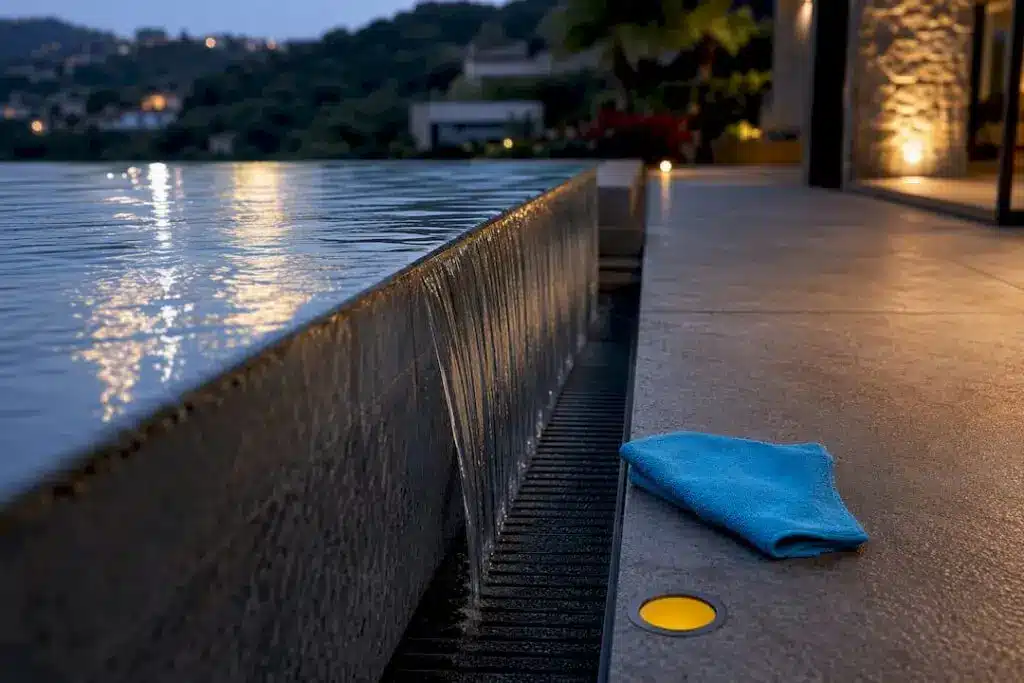
A zero-edge pool is built so the water sheets flush with the deck into a hidden collection channel, creating either a mirror-flat surface or a horizon-merging view. That seamless look comes from precision engineering, not luck. Expect a real cost premium and tighter construction tolerances than a standard pool, in exchange for an effect no ordinary edge can match.
TL;DR:
- Full perimeter overflow pools require highly precise leveling, which increases construction costs by 20 to 40 percent compared to perimeter systems with visible gutters.
- A convincing infinity edge depends on a meaningful slope or view, and flat lots may need a raised platform or artificial drop to achieve the illusion.
- The second plumbing system for overflow pools involves a catch basin and dedicated recirculation line, making engineering and waterproofing more complex and costly.
- Dark interior finishes enhance the reflective, mirror-like appearance but also show mineral buildup and absorb more heat, affecting long-term maintenance.
- Overflow pool evaporation is higher than standard pools, but water loss can be mitigated with variable-speed pumps, auto-fill systems, windbreak landscaping, and LED lighting.
Table of Contents
- What “zero edge” actually means in pool design
- Slot overflow vs perimeter overflow: which one fits your build?
- Does your lot actually support this design?
- The hydraulics behind the mirror effect
- Finish choices that make or break the illusion
- What ongoing maintenance actually looks like
- Water conservation strategies for an overflow pool
- Safety considerations unique to overflow edges
- What builders check that homeowners usually miss
- Ready to bring a zero-edge design to your backyard?
- Sources
What “zero edge” actually means in pool design
The industry uses several terms interchangeably, and that causes real confusion when homeowners start comparing bids. Here’s how builders actually use them.
- Zero-edge typically refers to a full-perimeter overflow, where water spills over every side into a surrounding trough or grate.
- Infinity edge, vanishing edge, and negative edge almost always describe a single overflow side, usually oriented toward a view, with the other three sides built as conventional walls.
- Perimeter overflow is the technical term for the zero-edge configuration, favored in commercial and resort work where water needs to spill on all sides for a lake-like effect.
A hillside home overlooking a valley is the classic single-edge infinity candidate. A flat urban lot with a courtyard aesthetic is where full perimeter overflow tends to show up instead, since there’s no single sightline to prioritize. Wefixuglypools has documented both approaches in past zero-edge pool projects, and the distinction between one-edge and full-perimeter systems is usually the first thing that needs sorting out with a client before design even starts.
Slot overflow vs perimeter overflow: which one fits your build?
The overflow system you choose determines how forgiving your construction budget and timeline can be. Interior slot systems, sometimes called knife-edge, hide the drainage channel inside a narrow gap at the pool’s edge, and that concealment is exactly what makes them harder to build.
- Slot systems demand millimeter-accurate leveling across the entire slot length, since even a hairline deviation breaks the continuous sheet of water and becomes expensive to fix once tile is set, as PoolArch’s technical comparison explains.
- Perimeter overflow systems use a visible gutter or grate that tolerates far wider installation variation, which is why PoolArch notes they’re often the choice for commercial or large-scale projects where maintenance access matters more than a completely invisible edge.
- Slot systems commonly carry a 20 to 40 percent price premium over perimeter systems at similar scale, according to Poolpad’s design breakdown.
Pro Tip: Ask any contractor bidding a slot system how they plan to verify level across the entire run before the coping goes down. If they don’t have a laser-level protocol ready to describe, that’s a red flag worth pressing on.
Slot edges suit minimalist luxury villas where the architecture is meant to disappear into the water. Gutter systems suit resorts, HOA amenities, and any pool where a maintenance crew needs to reach the channel without tearing out finish work.
Does your lot actually support this design?
Not every yard can pull off a convincing infinity effect, and figuring that out early saves a lot of wasted design fees. A single-edge vanishing pool needs either a real grade drop or a view worth framing. Without one, the water just spills into a trough with nothing dramatic on the other side.
- Check your slope first. A meaningful elevation change, even a modest one, is what sells the illusion that water disappears into the landscape.
- Order a geotechnical study before finalizing plans. Sites on slopes or near retaining structures often require soil-bearing analysis, since MM Pool Builders points out that structural work on graded lots adds real engineering complexity.
- Consider a raised platform if your lot is flat. Builders can create an artificial drop with an elevated structure, though that adds excavation and structural cost.
- Orient the edge to the view, not the property line. As Larry’s Pool Design Visualizer frames it, the overflow edge should dictate where the pool sits, not the other way around.
- Default to full perimeter overflow on flat, viewless lots. It delivers the mirror effect without needing a horizon to disappear into.
The hydraulics behind the mirror effect
Every zero-edge pool runs a second, separate plumbing system most homeowners never see until something goes wrong. Water spilling over the edge lands in a catch basin, then gets pumped back up through a dedicated recirculation line, distinct from the main filtration loop.
- The catch basin, sometimes called a surge or balance tank, has to hold surge volume plus a margin for splash and rain runoff, or it overflows during heavy use, according to Mossman Brothers Pools.
- Weir elevation, the exact height of the overflow lip, often needs calibration within fractions of an inch to keep the water sheeting evenly rather than pooling on one side.
- Undersized catch basins remain one of the more common engineering mistakes on these builds, and they stress the recirculation pump when they can’t handle peak flow.
- Infinity and slot-overflow pools can’t be prefabricated. Every basin volume and weir elevation gets calculated for that specific site and folded into the structural design and waterproofing plan.
Structural reinforcement, retaining walls where the drop requires them, geotechnical fees, and the extra labor hours for precision finishing are the line items that quietly inflate a zero-edge bid well past what a standard pool of the same square footage would cost. Ask for those broken out separately in any proposal.
Finish choices that make or break the illusion
The interior finish color does more work in a zero-edge pool than in almost any other design decision. Dark plaster or dark tile intensifies the mirror effect, turning the surface into something closer to polished stone, but it also shows every bit of scale buildup and absorbs more heat than a lighter finish.
- Dark interiors create the reflective look buyers usually picture, at the cost of visible mineral scale over time.
- Full-body precision porcelain coping, from suppliers like Serapool, holds tighter dimensional tolerances than natural stone, which matters enormously on slot systems where a fraction of an inch of variance ruins the sheeting effect.
- Grate profile on perimeter systems should prioritize removable, cleanable sections if the pool sits near trees or wind corridors, since debris turns an open gutter into a maintenance headache fast.
- Underwater LED lighting at the weir keeps the sheeting water visible after dark, according to Poolpad, which is worth budgeting for if the pool’s main draw is its evening presence.
Explore how these choices combine with fire features and landscaping in more detail through luxury pool feature pairings.
What ongoing maintenance actually looks like
Zero-edge pools run hotter on maintenance than standard pools, mostly because of evaporation and aeration. That constant sheeting motion exposes far more water surface to air than a still pool does.
- Install a reliable auto-fill system. Manual top-offs on a pool losing water to constant overflow become a chore fast.
- Inspect the catch basin and pump monthly. Debris buildup in the basin is the most common cause of reduced flow and uneven weir sheeting.
- Test water chemistry more frequently. Aeration from the overflow accelerates chemical consumption, and MM Pool Builders notes owners should expect faster depletion than a conventional pool.
- Watch for the failure signs early. Uneven sheeting along the weir almost always traces back to either basin sediment or a pump losing capacity.
Pro Tip: Keep a simple log of your auto-fill water usage. A sudden jump usually means a leak in the surge tank line, not just hot weather.
Water conservation strategies for an overflow pool
Constant sheeting water evaporates faster than a still pool surface, which raises a fair question for anyone weighing a zero-edge build against water use concerns. The good news is that the environmental footprint of an overflow pool is manageable with the right equipment choices, not something baked permanently into the design.
A variable-speed recirculation pump cuts energy use compared to a single-speed motor running at full output around the clock, since the overflow system only needs enough flow to maintain a clean sheet, not maximum throughput at all times. Pairing that with a smart auto-fill sensor prevents the common failure mode where a slow leak in the surge tank goes unnoticed for weeks, wasting far more water than evaporation alone ever would.
Pool covers designed for overflow edges exist, though they’re less common than on standard pools because they interrupt the visual effect when the pool isn’t in use. A more practical middle ground for many owners is windbreak landscaping, since wind is a major evaporation driver on an exposed sheeting surface, and a strategically placed hedge or wall can cut evaporative loss more than most owners expect. LED lighting upgrades also reduce the energy load of keeping the weir dramatic after dark compared to older halogen fixtures.
None of this makes a zero-edge pool water-neutral. It uses more water than a standard pool of the same size, full stop. But the gap closes considerably with variable-speed equipment, a properly sized auto-fill system, and basic wind mitigation in the landscape design.
Safety considerations unique to overflow edges
A flush edge changes how people and pets perceive the pool’s boundary, and that’s worth taking seriously before construction starts. Because there’s no raised lip or visible wall on the overflow side, small children and pets can have a harder time recognizing where the deck ends and the water begins, especially at night or from a distance.
Slip resistance on the surrounding deck and coping matters more here than on a standard pool, since that surface stays perpetually damp from the sheeting water. Textured porcelain or a honed stone finish with a higher coefficient of friction reduces that risk meaningfully compared to a smooth polished surface. Anti-entrapment covers on the catch basin’s suction points also need to meet the same safety standards as any pool drain, since the recirculation system pulls water continuously rather than intermittently.

For pools built near a real elevation drop, whether that’s a hillside infinity edge or a raised platform on a flat lot, guardrail or fencing requirements around the surrounding grade often apply even when the pool itself has no raised wall. Local building codes typically treat that drop the same way they’d treat a retaining wall or balcony, regardless of whether the water feature is the reason for the elevation change. Checking those code requirements with your municipality before finalizing the design avoids a costly redesign after permitting.
What builders check that homeowners usually miss
Vetting a zero-edge bid means asking pointed questions most homeowners never think to raise: leveling tolerances across the weir, the exact porcelain coping specification, surge tank volume against expected splash load, and the recirculation pump’s flow curve. A vague answer on weir tolerance, a surge tank sized without splash margin, or no geotechnical report on a sloped lot are the clearest warning signs a bid is underprepared. Projects walked through permitting and construction in similar urban areas demonstrate that pools which age well are the ones where these details got nailed down before the first shovel hit dirt, not fixed afterward.
— Brian
Ready to bring a zero-edge design to your backyard?
If you’ve made it this far, you already understand why a zero-edge build isn’t something to hand off to a general contractor moonlighting in pools. Some companies focus exclusively on transforming ordinary or aging backyards into custom water features, including perimeter overflow and infinity edge designs, for homeowners in metropolitan areas. That specialization means every weir calibration, surge tank sizing, and coping detail gets handled by a team experienced with these problems, rather than learning them on your job site.

Whether you’re starting from a blank yard or converting an existing pool into a zero-edge feature, our custom pool and renovation services cover both design and construction under one contract. If your current pool is the starting point rather than a fresh build, our pool remodeling and restoration team can walk you through what converting to an overflow edge would actually require on your specific site. Reach out for a design consultation and find out what your lot can realistically support.
Sources
- Interior Overflow Pool vs Perimeter Overflow Pool: Architecture, Technical Design and Cost Comparison
- Infinity Edge Pool Engineering & Site Grading (2026)
- Infinity pool ideas — Poolpad


