
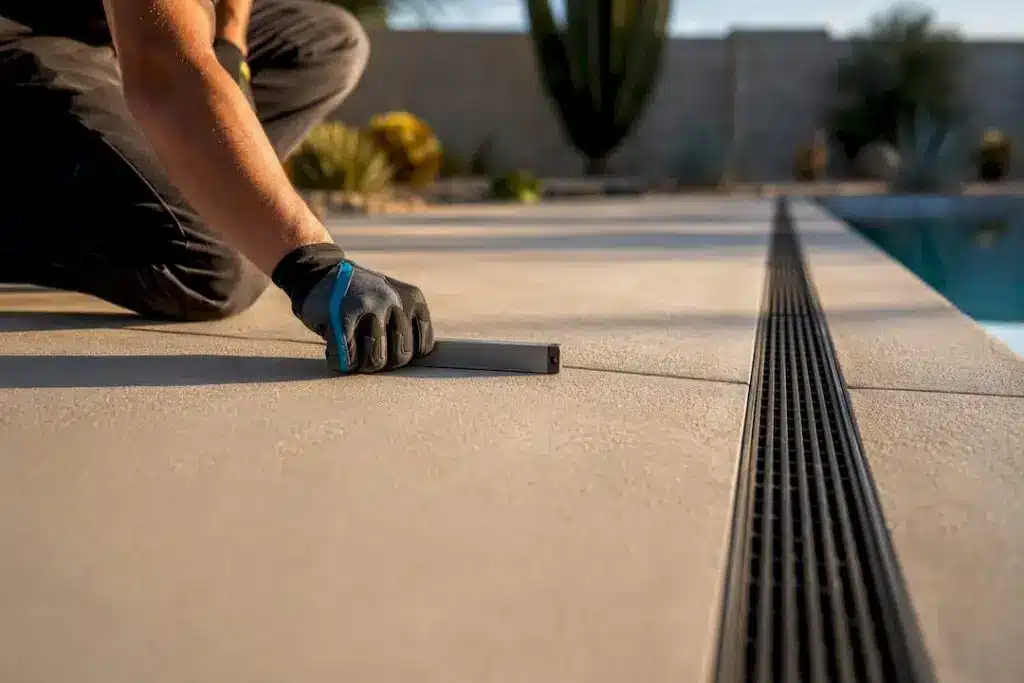
For most residential pools, the right fix is a perimeter channel or slot drain set into a deck that pitches toward it. Everything else about pool deck drain installation is detail work. The one rule that decides whether the whole system works: the deck must slope at least 1/8 inch per foot toward those drains, roughly 0.5% to 1%. Using industry-standard drainage guidance as the benchmark. If you’re not confident cutting or forming that grade yourself, that’s your cue to call a professional rather than guess.
TL;DR:
- Slopes of at least 1/8 inch per foot are essential for effective drainage, making proper grading the most critical factor in installation.
- Slot, trench, point, and micro channel drains suit different deck types and water loads, with choice depending on aesthetics, size, and overflow levels.
- PVC, polymer concrete, and stainless steel components outperform other materials in resisting pool chemicals and environmental degradation.
- Discharge lines must slope away at a minimum of 1% and direct water to approved drainage routes, avoiding connections to sanitary sewer systems.
- Proper installation involves careful planning, testing, and possibly professional grading assessments to prevent recurring puddles and deck damage.
Deck drainage problems causing cracks? See our concrete crack repair & sealing service »
Table of Contents
- What Types of Pool Deck Drains Should You Consider?
- Which Materials and Grates Actually Hold Up Around a Pool?
- How Much Slope Do You Actually Need, and Where Should Drains Discharge?
- How Do You Install Drains on a New Concrete Pool Deck?
- Can You Retrofit Drains Into an Existing Pool Deck?
- How Do You Maintain Pool Deck Drains and Fix Common Problems?
- What Has a Decade of Pool Remodeling Taught Wefixuglypools About Drainage?
- What’s the Real Verdict on DIY Pool Deck Drainage?
- Ready for a Professional Pool Deck Drainage Assessment?
- Where Can You Find More Installation Guidance?
- Sources
What Types of Pool Deck Drains Should You Consider?
Not every deck needs the same drain, and picking the wrong type is the most common mistake we see homeowners make before they’ve poured a single yard of concrete. The right choice depends on how much water the deck sheds, how the deck looks, and whether you’re building new or retrofitting.
- Slot drains. Narrow, nearly invisible surface openings that run in a line, often pre-sloped inside the kit itself. They’re the go-to for high-end aesthetics and for narrow retrofit cuts where you don’t want to tear up a whole slab.
- Channel or trench drains. Wider bodies with removable grates, built for standard perimeter capture around a typical backyard pool. These handle heavier splash-out and are the default for most new builds.
- Point or spot drains. Single catch basins placed at isolated low spots, like a corner where two slopes meet. Cheap and simple, but they don’t do much for a long run of deck edge.
- Micro channel drains. Compact versions of standard channels, useful in tight side yards or narrow walkways where a full-size trench body won’t fit.
Pre-sloped kits save labor because the pitch is built into the unit. Field-formed channels give you more control over depth and routing, but someone has to get the slope right by hand. According to drain-selection guidance from industry sources, scale should drive the decision: perimeter drains suit standard residential splash-out, while trench and slot systems handle larger decks or heavier overflow.
Which Materials and Grates Actually Hold Up Around a Pool?
Pool decks are one of the harshest environments a drainage product will ever sit in. Chlorine, salt, sunscreen residue, and constant wet/dry cycling chew through the wrong material fast.
- PVC or HDPE channel bodies resist chemical breakdown and won’t corrode from splash-out.
- Polymer concrete holds up under heavy foot traffic and UV exposure without cracking the way standard concrete channel bodies sometimes do.
- 316-grade stainless steel is the material of choice for grates and hardware in high-exposure zones, since it stands up to chlorinated and saltwater conditions far better than standard alloys.
- Avoid galvanized steel or bare aluminum entirely. Both degrade quickly once pool chemicals get into the mix, and you’ll be replacing hardware within a couple of seasons.
Grate selection matters just as much as the channel body. Look for slip-resistant surfaces with heel-proof openings, no wider than 1/2 inch, and ideally closer to 3/8 inch for genuine barefoot comfort. If the deck serves a pool used by kids, older adults, or anyone with mobility needs, keep ADA-style slip resistance and opening width in mind even where it’s not strictly required by code.
Pro Tip: Remove any protective tape from the drain body as soon as the concrete cures. In Phoenix-area heat, that tape can bake onto the plastic profile within days and warp the finish if you leave it on.
How Much Slope Do You Actually Need, and Where Should Drains Discharge?
The number to remember is 1/8 to 1/4 inch of fall per foot, which works out to about 0.5% to 1% grade. That range moves water toward the drain fast enough to avoid pooling but not so steep that it creates a tripping hazard or undermines the deck’s finish.
Water flowing the wrong direction, even slightly, is the single most common cause of standing puddles and premature deck failure.
Layout priorities, in order:
- The coping edge closest to the pool, since backflow into the pool itself is the outcome you’re avoiding above all else.
- Any low points created by the site’s natural grade or by equipment pads.
- Areas near high-volume features like waterfalls or spillovers, where splash-out concentrates.
Discharge is where a lot of otherwise solid installs go wrong. Route water to a dry well, a landscape swale, or an approved storm connection where your municipality permits it. Never tie a pool deck drain into a sanitary sewer line. NDS installation guidance recommends trenching discharge lines at a minimum 1% slope away from the structure, using flo-wells or pop-up emitters as the endpoint.
How Do You Install Drains on a New Concrete Pool Deck?
If you’re pouring a new deck from scratch, drain installation happens in lockstep with the concrete work, not after it. Here’s the sequence that keeps things square:
- Call for a utility locate before anything else, then finalize your drain layout on paper, marking catch basin positions and the direction of every slope.
- Set the channel or slot body as your screed rail. Most crews stake and level it first, since the drain becomes the reference point for the surrounding pour.
- Anchor the channel with rebar or stakes so it can’t float or shift once wet concrete surrounds it, and vibrate the concrete near the body to clear air pockets, a step product installation data flags as a common failure point when skipped.
- Join sections and connect to the catch basin and outlet pipe, dry fitting every joint before you glue anything permanently.
- Protect the grate opening during the pour. Manufacturer guidance for products like DECK-O-DRAIN calls for a board or the grate itself sitting in the channel while concrete is placed, which keeps grout from fouling the opening.
- Cure, then test. Once the slab cures, remove protective tape, install grates and seals, and run a hose along the full deck to confirm water tracks to the drain and out through the discharge line with no backflow.
Pro Tip: Dry-fit every coupling before gluing. A single misaligned joint under a cured slab means jackhammering concrete to fix it.
Can You Retrofit Drains Into an Existing Pool Deck?
Retrofitting is where a lot of homeowners either save real money or create a bigger mess than they started with, depending on the approach.
- Slot-drain retrofit. A narrow saw cut along the problem edge, anchor pads set into the cut, and a connection run to a nearby catch basin. This is the least disruptive option because it avoids demolishing the whole slab.
- Overlay approaches. A thin paver or decorative overlay can incorporate new drainage without removing the original slab, a reasonable route when the existing concrete is structurally sound but drains poorly.
- Continuous perimeter slot cuts generally beat scattering multiple point drains across a retrofit, since one narrow cut preserves more of the existing deck than several separate excavations.
Some jobs genuinely need excavation and a licensed contractor. If you’re seeing structural cracking, need to tie into a complicated municipal storm system, or have multiple low spots feeding different drainage paths, that’s beyond a weekend project. Our pool repair team handles exactly these tie-in scenarios regularly.
How Do You Maintain Pool Deck Drains and Fix Common Problems?
- Clear leaves, dirt, and sunscreen residue from grates and catch basins every week during swim season.
- Inspect seals and joints each spring for cracking or separation.
- Check for settling or low spots that create new puddles away from the drain line.
- Look for corrosion on any metal hardware, especially if you used anything other than 316 stainless.
If a drain clogs repeatedly, the catch basin is usually undersized for the runoff it’s handling, not just dirty. Heavy monsoon runoff or a large paved area feeding into one drain often calls for a second drain line rather than a bigger grate. And if tape baked onto the channel during a hot pour, remove it before it hardens further rather than trying to scrape it off months later. For deeper drainage failures, our guide on common residential drainage problems walks through diagnosis in more detail.
Pro Tip: If the same low spot keeps collecting water after two dry seasons, it’s a grading problem, not a drain problem. Regrading a small section beats adding drain after drain.

What Has a Decade of Pool Remodeling Taught Wefixuglypools About Drainage?
Over many years and numerous projects, professionals have seen almost every drainage failure a deck can produce, from decks poured dead flat to retrofits where three point drains fought each other instead of working together. Most calls we get aren’t about a drain failing outright. They’re about a deck that was never sloped correctly in the first place, so water finds the pool instead of the drain.
Signs you need us rather than another weekend with a trowel: standing water that returns within a day of clearing it, cracking near a drain body, or a discharge line that seems to dump water right back toward the foundation. Our professional pool repair guidance covers more of these decision points if you’re still weighing DIY against a call to us.
What’s the Real Verdict on DIY Pool Deck Drainage?

The conventional advice on this topic oversells the drain and undersells the slope. Homeowners obsess over which grate looks best or whether stainless beats polymer concrete, and those choices matter less than getting a consistent 1/8 to 1/4 inch per foot pitch across the entire deck. A beautiful slot drain set into a flat deck will still leave you with puddles. If you’re capable with a level and comfortable staking a screed rail, the new-build sequence in this guide is genuinely within reach for a motivated homeowner. Where DIY gets risky is discharge planning. Tying into the wrong system, or missing a required slope on the outlet line, creates problems you won’t see until the next heavy rain. That’s the piece I’d tell any homeowner to get a second opinion on before pouring anything.
Prioritize the slope check first, the discharge plan second, and the drain style last. Get those first two wrong and no amount of grate upgrade saves the deck.
— Brian
Ready for a Professional Pool Deck Drainage Assessment?
Professional crews offer a practical alternative to guessing at slope with a bubble level and hoping the concrete holds it. Such crews handle the full sequence, from grading assessment and catch basin placement to drain installation and discharge tie-in, on decks in service areas.

If your deck already has standing water problems or you’re planning a new pour and want the grading done right the first time, our pool remodeling and restoration services cover resurfacing, regrading, and drain installation as part of the same project. Reach out and schedule an inspection so we can walk the site, check existing slope, and tell you honestly whether it’s a drainage fix or a bigger regrading job.
Where Can You Find More Installation Guidance?
- Manufacturer install sheets like DECK-O-DRAIN’s concrete deck drainage guidance and NDS’s patio and pool installation instructions.
- Material comparisons from Trenchdrain’s pool trench drain guide.
- Always confirm slope and discharge rules against your local building code and call for a utility locate before digging.
Sources
- Pool Deck Drainage Solutions | Stormwater Drainage
- NDS product information — channel drains and grates
- How to Install a Slot Drain on a Pool Deck or Patio — Global Drain Technologies
- Pool Trench Drains | Trenchdrain


