Pool slide cost has no single price tag, because the slide itself is often the smaller line on the quote. Slide type and the site work behind it drive the total, and CPSC safety guidance and manufacturer installation envelopes decide what that work must include. We at We Fix Ugly Pools® handle the depth and deck work that so often sets the final number.
TL;DR:
- Prices vary by slide class: bolt on models need a sound deck, while custom concrete slides add design, forming, reinforcement, and on site labor.
- Installation quotes should separate freight, footings, deck repairs, plumbing, removal, permits, and labor; narrow access or crane needs can raise delivery costs.
- The CPSC says slides generally should not sit over water less than 3 feet deep; manufacturers may require more depth and clearance.
- Before buying used, inspect the surface, ladder, hardware, plumbing, and parts availability, then verify the model meets your pool’s depth and clearance requirements.
- For comparable quotes, send every installer the same model, pool depth measurements, deck photos, clearance dimensions, and access notes, and request each cost in writing.
Table of Contents
- How much does each type of pool slide cost?
- What installation and site prep add to the bill
- Which safety rules and depth limits can raise your cost?
- Is a used pool slide a smart way to save?
- How do you estimate your total slide project budget?
- What does a remodeling specialist see that others miss?
- When is it worth spending more on a slide?
- How we can help with your slide project
- FAQ
- Sources
How much does each type of pool slide cost?
Start by deciding which class of slide you actually want, because each one pulls your budget in a different direction. We are deliberately not quoting dollar bands here. No vetted pricing study sits behind a universal number, and a figure pulled from thin air would only set you up for a bad surprise at the quote stage. What we can give you is the ranking, the logic behind it, and the variables that move each class up or down. Ask for written quotes with the model name and every line item so you can compare real numbers.
- Inflatable and toy-style slides: These sit at the bottom of the purchase-price scale. They are built for seasonal splash play, not for permanent use, and they tend to wear out faster under daily family traffic. They also lack the engineered support that an inground residential slide relies on, so they suit a different job entirely.
- Deck-mounted, bolt-on consumer slides: You pay the retail price of the slide plus modest mounting labor. The slide anchors to a deck or coping that is already in good shape. Cost climbs quickly if that deck needs reinforcement first.
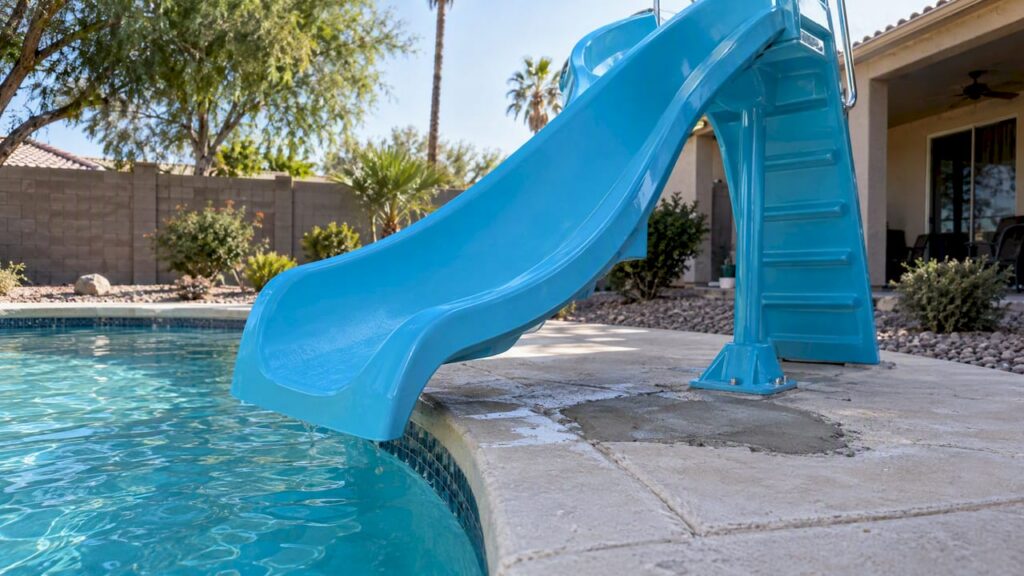
- Molded polyethylene and residential fiberglass slides: This is the middle of the market. Length, number of curves, finish and color change the price, and so does how far the unit has to ship. A tall, multi-curve model costs more to build, more to freight and more to set.
- Premium fiberglass and stainless slides: Material is the story here. Heavier units cost more to ship, need more hands to handle, and often call for stronger support. Commercial-grade construction raises the purchase price again, even when the slide ends up in a backyard.
- Custom concrete-built slides: These sit at the top of the cost range. You are paying for design, forming, rebar, shaping and finishing, all done on site. Most homeowners build one as part of a larger remodel, which spreads the labor across the whole project.
A good rule of thumb: the more permanent and the more customized the slide, the more of your total shifts from the product to the labor and engineering behind it.
Why material and height change the price
Height matters twice. A taller slide costs more to manufacture, and it raises the exit speed, which pushes up the water depth and clearance the manufacturer requires. That connects directly to the next cost layer, so we cover it right after this.
Material affects long-term cost too. Slides built for heavy family use hold their finish and hardware longer. Budget models can fade under intense sun, and in the Phoenix area UV exposure is a real wear factor. If you plan to keep the slide for years, ask each installer how the finish performs in sustained heat.
Finally, consider the slide as part of the whole pool. If you are already planning a rebuild, our custom pools work lets you design the slide, the depth and the deck together instead of retrofitting later. Buyers weighing a concrete slide may also want to preview the layout first. A 3D pool visualization helps you see placement and spot clearance problems before anyone pours a footing.
What installation and site prep add to the bill
The slide is only half the purchase. Installation is where homeowners get surprised, because the work depends on your pool, your deck and your yard, not on the slide’s catalog page.
- Footings and support: Manufacturer manuals specify how a slide must be anchored. The S.R. Smith Garden Ride slide manual lays out strict placement requirements, and the SlideAway owner’s manual lists footing requirements and warns that improper installation can void the warranty. If your deck cannot carry the load, someone has to reinforce it or pour new footings.
- Concrete-set versus bolt-on installs: Bolt-on installs use less material and less labor. Concrete-set installs add cutting, digging, forming and curing time, which is why they cost more and take longer.
- Delivery and lifting: Long, heavy slides can need freight handling, extra crew or a crane, especially with a narrow side yard, a block wall or no equipment access. Tell every installer about access up front.
- Plumbing and water feed: Water-fed slides need supply piping, valves and often a pump or a tie-in to existing equipment. The River Run slide manual shows how plumbing details and fitting placement are part of the install, not an afterthought.
- Removal and deck repair: Pulling out an old slide leaves anchor holes, stains and sometimes cracked coping. Patching and refinishing that area is a real cost, and it is often cheaper to do it in the same visit.
Pro Tip: Photograph the install area from three angles, measure the distance from the pool edge to the nearest wall, and note any gate width. Every installer will ask, and the answers change the quote.
Many of these items overlap with repair and resurfacing work. If your coping or deck is already tired, our swimming pool repair team can fold that into one scope, so you are not paying for mobilization twice.
Which safety rules and depth limits can raise your cost?
Safety decides whether your pool can take a slide at all, and fixing a noncompliant pool is often the most expensive line on the project.
The U.S. Consumer Product Safety Commission has said that slides should generally not be installed over water less than 3 feet deep, and it stresses analyzing the site before installation so depth and clearance meet the manufacturer’s safety envelope, according to the CPSC’s swimming pool slide standard announcement. Manufacturers go further. The Garden Ride manual describes minimum exit depth and clearance requirements, with the required depth increasing within a few feet of the exit, and it warns that missing them can void the warranty and create serious hazards.
What does that mean for your budget?
- Shallow runout: If the water at the slide exit is too shallow, you may need a depth conversion or a different slide location. See our guide to pool depth configuration options for how depth can be modified.
- Footings and added support: Meeting a manufacturer’s support rules can mean extra concrete, which adds both materials and labor.
- Clearance zones: Overhangs, fences and nearby equipment can disqualify a spot, pushing the slide to a costlier location with more plumbing or deck work.
- Warranty conditions: An install that ignores the manual can leave you carrying the repair bill if something fails.
Safety is also why we treat compliance as a cost to plan for, not a hurdle to dodge. Our related guide on pool diving board safety rules covers similar homeowner obligations.
CPSC injury data shows thousands of emergency-room-treated pool-related injuries each year, with children making up a substantial share of slide injuries. Those numbers are the best argument for paying for the depth and support work that keeps a slide inside its safe envelope.
Is a used pool slide a smart way to save?
Sometimes, but a low sticker price can hide structural and parts costs that erase the savings. A used slide arrives without a fresh warranty, and the manual’s installation rules still apply to it.
Before you hand over cash, work through this checklist:
- Check the ladder and hardware for rust, loose bolts and stripped threads.
- Inspect the slide surface for cracks, deep gouges, rough spots and chalky UV damage.
- Look at every plumbing fitting and gasket on water-fed models.
- Confirm the model name and that all manufacturer parts are present, including mounting hardware and the manual.
- Ask whether the seller has repaired it, and who did the work.
- Ask whether replacement parts are still available for that model.
- Find out whether any warranty transfers to you, since many do not.
Used models can also be the wrong size for your pool. A slide that needs more exit depth than your pool offers leads to depth work, new footings or a deck patch. At that point you have spent the savings and then some. Run the used slide through the same safety envelope as a new one before you commit.
How do you estimate your total slide project budget?
Build the budget from line items instead of a single number. That is the only way to compare quotes fairly and avoid underestimating the project.
- Slide unit cost: the model, color and any accessories.
- Freight and delivery: the shipping and any special handling.
- Footings and concrete: new pours or reinforcement.
- Deck work: cutting, patching, resurfacing or coping repair.
- Plumbing: supply lines, valves and pump connections for water-fed slides.
- Electrical: only if a pump or lighting requires it.
- Permits: check with your local building department.
- Removal: taking out and disposing of the old slide.
- Installer labor: set, anchor and test.
- Finish work: sealing, caulking and cosmetic touch-ups.
- Contingency: a cushion for what you cannot see yet. We suggest setting aside a contingency cushion, since older pools tend to reveal surprises once work begins.
Think about three scenarios instead of three guesses. A budget scenario is a small bolt-on slide on a sound deck over an already deep pool, where freight and a few hours of labor are the main variables. A standard scenario is a mid-range molded slide that needs new footings and some plumbing, where site access and concrete work move the price most. A premium scenario is a custom or high-end unit paired with depth conversion, deck resurfacing and finish work, where scope and materials dominate. We leave dollar amounts off because the right figures depend on your yard and your quotes.
Before you request quotes, gather the pool’s depth at several points, photos of the deck and coping, measurements to walls and fences, the slide model you want, and notes on access. Send the identical package to every installer.
What does a remodeling specialist see that others miss?
We bring remodeling experience to every slide conversation. That track record taught us to hunt for unknowns first, because a hidden crack or a too-shallow runout costs far more once the slide is already on site.
In the Phoenix area, slide installs often arrive alongside other work: resurfacing, coping repair and depth conversions. It makes sense to do these together, since the deck is open and the crew is already there. We usually sequence the job by fixing structure and depth first, then plumbing, then the slide, then finishes. That order reduces change orders, because problems surface before the expensive pieces go in.

When is it worth spending more on a slide?
My view is simple: if the slide will see daily family use, buy the more durable one and pay for proper support. Heavy use punishes thin finishes and light hardware, and a slide that fades or loosens in a couple of seasons costs more over time than one built to last. A budget slide is fine when use is occasional, the deck is sound and the pool already has generous depth. Whatever you choose, put safety first and set aside contingency money. The depth and footing work is where a cheap project becomes an expensive one, and skipping it is the one place I would never economize.
— Brian
How we can help with your slide project

Our team can help with the work a slide install tends to need:
- Custom pool features, including slides integrated into your design
- Depth conversions when your pool needs more runout
- Pool resurfacing and deck refinishing tied to the install
- Full coordination of footings, plumbing and finish work
When we estimate, we walk the site, measure depth and clearances, and put every line item in writing so you can compare it against other quotes. Ask us for the documentation behind each number. Ready for a real price? Request an inspection and quote and we will tell you what your pool needs before you buy.
FAQ
How much does a pool slide cost overall?
Total cost depends mainly on the slide type and the site work it requires. Inflatable units sit at the low end, while custom concrete slides sit at the top. Get itemized quotes that include footings, plumbing and delivery.
Does a pool slide increase insurance?
It can, since slides add liability exposure. We cannot quote a premium change, so call your insurer before you buy and ask whether they require specific safety features or inspections.
How deep must the water be for a pool slide?
The CPSC says slides should generally not be installed over water less than 3 feet deep. Your manufacturer’s manual may require more, so follow the stricter of the two.
Can I install a pool slide myself?
Manuals describe strict footing, placement and plumbing requirements, and improper installation can void your warranty. A professional install protects both safety and coverage, especially when depth or deck work is involved.