
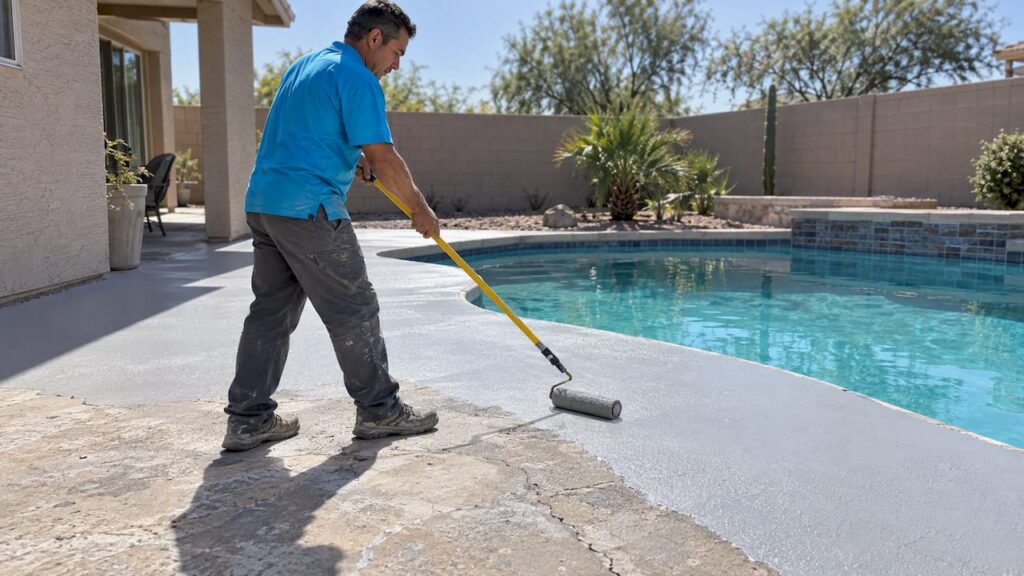
Resurfacing a Phoenix pool deck typically costs a range per square foot, with most homeowners paying a moderate amount for a standard acrylic or polyaspartic overlay. The material you choose, how much crack or moisture repair the slab needs, and the total square footage all push that number up or down. The sections below break down each variable so you can turn this range into a number that actually fits your deck.
TL;DR:
- The total cost varies significantly based on slab condition and repair needs, with structural issues requiring full demo and repour costing the most.
- Acrylic cool deck is the standard, cost-effective option for heat performance, but it has a shorter lifespan compared to polyaspartic systems, which cost more upfront.
- Site-condition repairs, especially moisture testing and crack filling, often cause the biggest budget surprises and should be prioritized during inspections.
- Scheduling in fall, winter, or early spring is recommended to avoid Phoenix’s extreme summer heat that can compromise coating adhesion.
- A thorough written quote must include scope, moisture testing, product specifics, timeline, warranty, and cleanup to avoid hidden costs and red flags.
Table of Contents
- Concrete cost breakdown: per-square-foot ranges and example job totals for Phoenix
- Material options: how acrylic cool deck, polyaspartic, and stone compare for Phoenix
- Site-condition repairs and diagnostic tests that commonly raise price
- Timeline and scheduling: how long jobs take and when to resurface in Phoenix
- One concise contractor-vetting checklist: what to get in a quote and red flags
- Local experience: how We Fix Ugly Pools scopes and prices resurfacing projects in Phoenix
- What this cost data actually tells Phoenix homeowners
- What to expect from a We Fix Ugly Pools estimate and next steps
- Sources
- FAQ
Concrete cost breakdown: per-square-foot ranges and example job totals for Phoenix
Pricing a pool deck project starts with square footage, but the material and condition of your existing slab do most of the work in determining where you land. Here is how the major categories typically stack up in the Phoenix market:
- Minor repairs and spot fixes: a modest cost per square foot, often used for small cracks or isolated delamination rather than a full resurface.
- Acrylic overlay (cool deck): a common choice for Phoenix backyards because it balances cost with heat performance.
- Polyaspartic flake systems: typically priced higher for faster install times and better chip and UV resistance.
- Stamped and colored concrete: priced above mid-range due to decorative tooling and joint work.
- Pavers or travertine: the premium tier for natural stone or manufactured pavers.
- Full demo and repour: generally the most expensive option, reserved for decks with structural slab failure that overlays cannot fix.
Applying typical cost ranges to various project sizes illustrates how totals scale. Smaller decks common for backyard pools may cost a few thousand dollars at the low end of an acrylic overlay and higher at premium finishes. Mid-sized decks often cost several thousand dollars more, and large, resort-style decks can be significantly more expensive depending on material choice.
Most written quotes include surface cleaning, crack filling, the resurfacing material and labor, and basic color sealing. What often lands as a separate line item, or gets left out of a lowball bid entirely, includes demo and haul-away of old material, permit fees where the work affects structural elements, drainage corrections around the pool’s perimeter, and repair of coping or tile that borders the deck. If a quote looks unusually low compared to others you have collected, check whether these items are missing before assuming it is the better deal. Our pool resurfacing service page breaks down what a Phoenix-specific scope typically includes.
Material options: how acrylic cool deck, polyaspartic, and stone compare for Phoenix
Material choice is where most of the cost variation in this guide comes from, and it is also where Phoenix’s climate matters most. A material that performs well in a milder climate can fail faster here if it was not designed for extreme heat and intense UV exposure.
- Acrylic cool deck: Typically $6 to $10 per square foot, this remains the standard choice for Phoenix because the textured, breathable finish stays cooler underfoot than smooth concrete. Lighter colors and breathable acrylic overlays can meaningfully reduce surface temperature compared with darker, denser materials, according to cool pavement research from the Heat Island Group at Lawrence Berkeley Lab. The tradeoff is a shorter lifespan than polyaspartic systems and more frequent recoating.
- Polyaspartic and polyurea systems: Running $9 to $15 per square foot, these coatings can often be installed in a single day, according to manufacturer system guides for one-day polyaspartic products, which also document the strict temperature and substrate prep limits that make Phoenix installs trickier than they sound. They resist UV fading and chipping better than acrylic, but patch repairs can show as visible seams if the original batch color has weathered.
- Stamped and colored concrete: At $10 to $16 per square foot, stamped concrete gives a stone-like look without stone pricing. The risk is cracking along control joints if they are not planned correctly for Arizona’s expansion and contraction cycles, so joint layout deserves as much attention as the stamp pattern itself.
- Pavers and travertine: The premium option at $15 to $25 per square foot. Travertine in particular stays noticeably cooler to the touch than poured concrete, which matters during Phoenix summers, though it requires a properly prepared base to prevent settling over time. For a deeper look at how travertine performs and what drives its cost, SurfacesGalore’s guide to travertine pool decks covers the material in detail.
If budget is the priority, acrylic cool deck is the default for good reason. If you want the longest stretch between recoats and can tolerate a higher upfront cost, polyaspartic systems are worth the premium. Homeowners chasing a high-end look, and who are willing to pay for base prep done right, tend to land on pavers or travertine. Our Cool Deck repair guide walks through acrylic-specific repair timelines if that is the direction you are leaning.
Site-condition repairs and diagnostic tests that commonly raise price
The biggest gap between a contractor’s initial estimate and the final invoice almost always comes from what is under the surface, not the finish coat itself. Phoenix slabs move with heat cycles and soil conditions in ways that create predictable, and predictably expensive, problems.
- Crack filling and saw-cutting: Minor cracks typically add $200 to $600 per repair, while larger structural cracks requiring saw-cutting and rebar work can run $800 to $2,000 or more.
- Slab patching: Isolated patching for delaminated or spalled concrete generally adds $5 to $10 per square foot of affected area on top of the base resurfacing cost.
- Joint and bond-beam repair: Damage at the bond beam, where the deck meets the pool shell, often adds $500 to $1,500 depending on severity.
- Coping and tile repair: Cracked or loose coping stones typically run $15 to $40 per linear foot to replace.
Deciding between a surface overlay and a full demo and repour comes down to how much of the slab has failed. If cracking is isolated and the slab is structurally sound, an overlay after proper repair is usually the right call. If large sections show structural movement or repeated cracking in the same areas, repour becomes the more defensible long-term choice even though it costs more upfront.
One test that separates careful contractors from corner-cutters is moisture testing. ASTM F2170 is the standard method for measuring relative humidity inside a concrete slab using in-situ probes, and it matters because coatings applied over a slab with excess internal moisture can fail through delamination or blistering within months. Asking whether your contractor performs this test, or an equivalent moisture check, before committing to a coating system is one of the simplest ways to protect your investment. Pool tile, coping, and bond-beam damage often surface during this same inspection phase, which is why a thorough site visit before any quote is finalized tends to produce more accurate numbers than a drive-by estimate.

Timeline and scheduling: how long jobs take and when to resurface in Phoenix
Install time varies significantly by material. Polyaspartic systems can often be completed in a single day thanks to their fast cure chemistry, while acrylic overlays typically take two to three days to allow for proper curing between coats. Stamped concrete projects usually run three to five days once you factor in forming, pouring, stamping, and sealing.

Phoenix heat creates real scheduling constraints that homeowners in milder climates do not face. NWS climate data for the Phoenix area shows summer temperatures that regularly exceed the safe application range for many coating products, which can cause flash curing, bubbling, or poor adhesion. Most experienced contractors recommend scheduling resurfacing work in the fall, winter, or early spring months, both to avoid these temperature extremes and to keep the pool usable during the hottest stretch of the year.
After installation, plan on keeping the deck shaded where possible during the first few days, following your contractor’s watering or curing instructions, and keeping foot traffic off the surface for the exclusion period they specify. Early-season scheduling gives you a cushion if weather delays push the timeline back.
One concise contractor-vetting checklist: what to get in a quote and red flags
A written quote is the only reliable way to compare bids, and it needs to cover more than just a total price.
- Scope of work in writing, including substrate prep, specific crack and repair items, and the exact material or product name being used.
- Moisture testing confirmation, ideally referencing ASTM F2170 or an equivalent method, especially for coating systems.
- Material and brand names, not just a category like “acrylic coating,” so you can research the product’s track record.
- Project timeline, including start date, expected duration, and any weather contingencies.
- Warranty terms in writing, covering both material defects and workmanship separately.
- Cleanup and haul-away responsibility, specified clearly so it is not a surprise add-on later.
- License and insurance verification, which you can confirm directly with the Arizona Registrar of Contractors.
Pro Tip: Ask every contractor for two local references from jobs completed in the past year, then actually call them and ask if the final price matched the original quote.
Red flags worth walking away from include a scope that stays vague even after you ask follow-up questions, a price noticeably lower than every other bid with no explanation for the gap, no firm timeline, or reluctance to put a warranty in writing. Once you have quotes using the same checklist, comparing them side by side becomes far easier than comparing dollar totals alone.
Local experience: how We Fix Ugly Pools scopes and prices resurfacing projects in Phoenix
We Fix Ugly Pools has spent over a decade remodeling pools across the Greater Phoenix area, and resurfacing work has taught us that the failures homeowners notice first, faded color, rough or peeling texture, are usually symptoms of something underneath: slab cracking, trapped moisture, or a previous repair that was never done right.
Our estimate process starts with a visual inspection of the deck and surrounding coping, followed by substrate checks to identify cracking patterns or moisture concerns before recommending a specific material. We would rather flag a repair-first scope upfront than sell a coating that is likely to fail within a year. From there, we walk homeowners through budget tiers so they can see how acrylic, polyaspartic, or stone options compare for their specific deck, along with a realistic timeline.
Working with a remodel specialist rather than a general handyman tends to reduce long-term cost, not because the upfront number is always lower, but because getting the repair and material choice right the first time avoids paying twice. You can see more on our Resurfacing & Restoration services page.
What this cost data actually tells Phoenix homeowners
The conventional advice on pool deck resurfacing treats it like a simple material comparison: pick acrylic if you are budget-conscious, pick polyaspartic if you want durability. That framing undersells the real cost driver, which is slab condition, not finish choice. A beautiful polyaspartic coating applied over an untested, moisture-compromised slab will fail faster than a basic acrylic overlay applied correctly over a well-prepped surface.
If there is one thing worth prioritizing before picking a material, it is insisting on a real substrate inspection, including moisture testing where coatings are involved. Homeowners who skip this step and chase the lowest bid tend to be the ones recoating again within two or three years. The slab is the foundation of the entire project, literally and financially, and no amount of color or texture choice fixes a prep job done poorly.
— Brian
What to expect from a We Fix Ugly Pools estimate and next steps
A free estimate from We Fix Ugly Pools gets you an on-site inspection of your deck’s current condition, a clear recommendation on whether repair, overlay, or full resurfacing fits your situation, a rough cost range based on your actual square footage and material preference, and a realistic timeline built around Phoenix’s seasonal constraints.

Before your visit, it helps to have your deck’s approximate square footage, photos of any visible cracks or discoloration, and the date of your last resurfacing if you know it. That information lets us give you a more accurate picture on the first visit instead of a rough guess that changes later. If you are ready to get a number specific to your backyard, request a quote through our Pool Resurfacing page and we will get a visit scheduled.
Sources
These are the technical references behind the figures and recommendations in this guide:
- Cool pavements — Heat Island Group (Lawrence Berkeley Lab)
- Phoenix climate summary — National Weather Service (PSR)
- ASTM F2170-19a — Standard Test Method for Determining Relative Humidity in Concrete
- Simiron SimFlake One-Day Polyaspartic system guide
FAQ
What is the average cost to resurface a pool deck?
Most Phoenix homeowners pay a range per square foot depending on the material, with acrylic overlays generally less expensive and stone or stamped concrete among the higher-cost options. A typical medium-sized deck often costs several thousand dollars for a standard overlay project.
How much does it cost to replaster a pool of a similar size?
Replastering the pool shell itself is priced separately from deck resurfacing and depends on surface area and plaster type, not deck square footage. Homeowners pricing both projects together should request separate line items from their contractor so the deck and shell costs are not blended into one confusing number.
What time of year is best to resurface a pool deck in Phoenix?
Fall, winter, and early spring are the preferred windows because Phoenix summer temperatures often exceed the safe application range for many coating products, according to NWS climate data. Scheduling outside peak heat also keeps your pool usable during the months you are most likely to want it.
What is the best pool deck resurfacing material for Phoenix homes?
There is no single best material since the right choice depends on budget, heat tolerance, and how long you want between recoats. Acrylic cool deck is the most common choice for its breathable, cooler-underfoot texture, while polyaspartic systems offer longer-lasting UV and chip resistance for homeowners willing to pay more upfront.
Are financing or payment plans available for pool deck resurfacing?
Many Phoenix pool remodeling companies discuss payment options directly during the estimate process since terms depend on project scope and size. Ask about financing availability when you schedule your on-site inspection so it can be factored into your final decision.


