Pool certification is a voluntary industry credential that verifies a professional’s training in a specific area, such as water chemistry, equipment operation, or pool construction. As a homeowner planning a remodel or new build, you don’t earn this credential yourself — you hire someone who has. The right certification signals that your contractor or service tech has completed formal coursework, passed an exam, and keeps their knowledge current through continuing education.
Here’s a quick decision rule before we go deeper:
- Remodel or new construction: Require builder credentials like the Certified Builder Professional (CBP) through the PHTA/GENESIS pathway, plus a valid state contractor license.
- Routine service and water chemistry: Operator credentials like the Certified Pool Operator (CPO) are the relevant standard to ask about.
- Both situations: Always verify state contractor licensing separately from any certification, since certifications and licenses are not the same thing.
Table of Contents
- What pool certification actually means: CPO, CBP, and PHTA/GENESIS
- Certification vs. contractor license: why you need to verify both
- How to verify a professional’s credentials before you hire
- What hiring a certified pro actually delivers — and where the limits are
- When certification should drive your hiring decision
- Red flags to watch for and contract language that protects you
- Six steps to hire a certified professional for your remodel
- Key Takeaways
- What most homeowners get wrong about pool credentials
- Ready to work with a team that carries the credentials to back it up?
- Authoritative sources to verify certifications and licensing
What pool certification actually means: CPO, CBP, and PHTA/GENESIS
Three credentials come up most often when you’re vetting pool professionals.
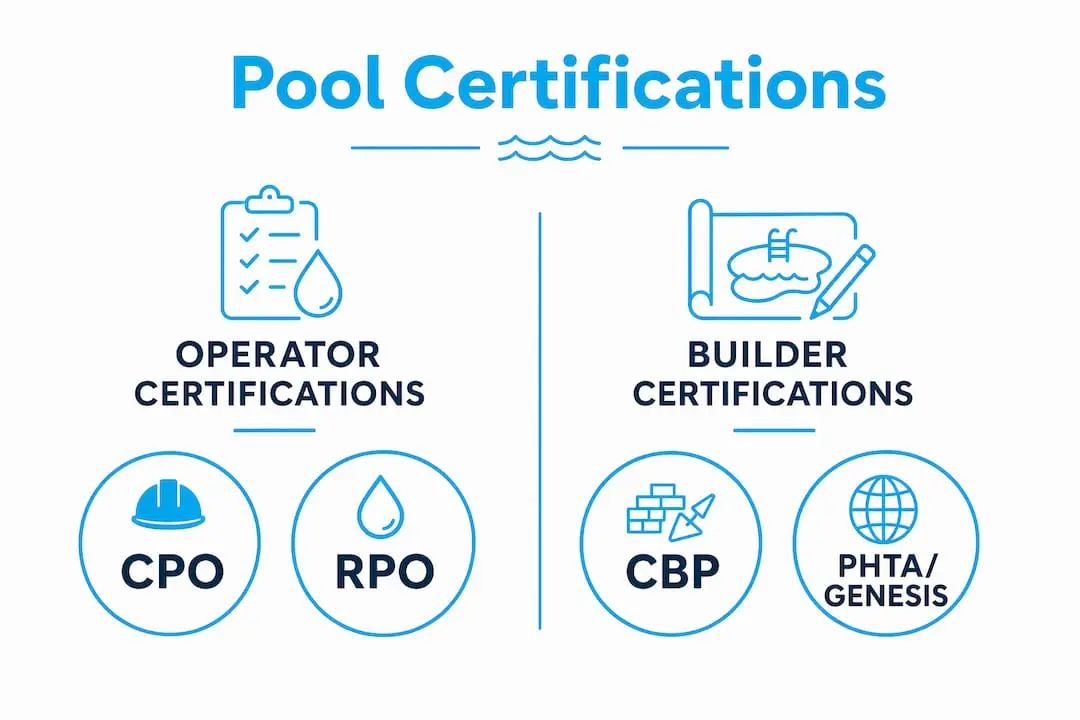
Certified Pool Operator (CPO) is the industry standard for pool operators. Issued through the Pool & Hot Tub Alliance (PHTA), the CPO program covers water chemistry, filtration, testing, equipment maintenance, and safety. Training runs as a two-day classroom course or a blended online-plus-one-day format, and candidates must pass an exam to earn the credential. The CPO certificate is typically valid for five years, and the program awards continuing education credits (CEUs) recognized by organizations like NEHA. For residential homeowners, the CPO is most relevant when you’re hiring a service technician for ongoing chemical maintenance.
Certified Builder Professional (CBP) is the credential you should ask about when hiring for a remodel or new construction. Delivered through the PHTA/GENESIS pathway, the CBP covers hydraulics, shotcrete, waterproofing, tile and coping, geotechnical and structural engineering, and code compliance across concrete, vinyl liner, and fiberglass construction. This scope maps directly to what a remodel actually involves.
| Credential | Best for | Primary focus | Homeowner relevance | How to verify | CEU/renewal |
|---|---|---|---|---|---|
| CPO | Service technicians, operators | Water chemistry, safety, equipment | Routine maintenance, chemical service | Request certificate; confirm PHTA issuance | CEUs at renewal; 5-year validity typical |
| CBP (PHTA/GENESIS) | Builders, remodelers | Hydraulics, structural, code compliance, finishes | Remodels, new builds, structural repairs | Request certificate; verify GENESIS/PHTA registry | Ongoing CEUs; check recent training dates |
Certification vs. contractor license: why you need to verify both
Certifications are voluntary industry credentials. A state contractor license is a government-issued legal authority to perform regulated trade work. Confusing the two is one of the most common and costly mistakes homeowners make.
For a pool remodel, licensed trades typically include electrical, plumbing, and structural or concrete work. These require state or local contractor licenses, not just industry certifications. A professional can hold a CBP and still need a separate plumbing or electrical license to legally perform that work in your state. Permits, inspections, and your homeowner’s insurance all depend on licensed work being performed by properly credentialed tradespeople.
Local requirements add another layer. Some jurisdictions require a Registered Pool Operator for public or commercial pools and specify their own application steps, exam requirements, and renewal rules. Residential remodels are governed differently, but local health departments and building departments can still impose conditions on your project.
Pro Tip: Go to your state contractor board’s website and run a license number search before you sign anything. Most state boards offer a free online lookup that shows license status, scope of work, and any disciplinary history.
How to verify a professional’s credentials before you hire
Asking for a certificate is step one. Knowing what to do with it is what separates informed homeowners from those who get burned.
- Request the certificate copy. Note the credential name (CPO or CBP), the issuing body (PHTA or GENESIS), and the issue and expiration dates.
- Verify through the issuing body. Cross-check the certificate against the PHTA or GENESIS registry. A certificate that can’t be verified is a red flag.
- Check CEU records and recent training dates. Ongoing education is a stronger signal of current competence than a certificate earned years ago, especially as codes and technology evolve.
- Confirm state license status. Use your state contractor board’s online search to verify the license number, scope, and standing.
- Request insurance declarations. Ask for a current certificate of insurance showing general liability and workers’ compensation.
- Ask for a project portfolio tied to references. Photos of completed work matched to a homeowner you can call tell you more than any credential alone.
For remodeling interviews specifically, ask: How have you handled hydraulic redesigns on similar projects? Who pulls the permits, and how do you manage inspections? What subcontractors do you use, and are they licensed?
Pro Tip: Ask for a current project photo portfolio and at least two references from jobs with a similar scope to yours. A builder who hesitates to provide either is telling you something.
What hiring a certified pro actually delivers — and where the limits are
The core benefit is liability reduction. Certified professionals are trained to identify hazards early, which tends to reduce insurance claims, health-department violations, and costly callbacks. For remodels, a CBP-credentialed builder brings code awareness and construction best practices that protect your investment structurally.
The limits matter just as much. A CPO is an operator credential, not a construction credential. Hiring a CPO for structural or electrical remodel work is a specialty mismatch that can lead to serious problems. Certifications also don’t replace state contractor licenses; a certified builder still needs the appropriate trade licenses for regulated work.
On cost: certified professionals often charge 15–30% more than uncertified workers. Think of that premium as project insurance. Fewer callbacks, fewer warranty disputes, and a lower probability of a safety violation tend to justify the difference for most homeowners tackling a major remodel.
| Signal | What it tells you | Validity period |
|---|---|---|
| CPO certificate | Operator trained in chemistry and safety | Typically 5 years |
| CBP certificate | Builder trained in construction and code compliance | Ongoing CEUs; check recent training dates |
| Recent CEUs | Current knowledge of evolving codes and technology | Ongoing |
| State contractor license | Legal authority to perform regulated trade work | Per state renewal schedule |
CEUs and recent training dates are often the most telling data point. An old certificate with no continuing education history is a weaker signal than a newer certificate with documented coursework.
When certification should drive your hiring decision
For a major remodel — resurfacing, replastering, hydraulic upgrades, equipment replacement, or structural repairs — the CBP credential is the one to prioritize. These projects touch the systems that determine your pool’s long-term safety and performance. Understanding custom pool construction phases helps you see exactly where builder credentials matter most.
For routine chemical service and water maintenance, the CPO is the relevant credential. A service tech who holds a current CPO and can show recent CEUs is well-qualified for that scope.
Simple cosmetic upgrades — new tile, coping replacement, or minor deck work that doesn’t affect hydraulics or structure — may not require a CBP, but you still need a licensed contractor for any permitted work. When in doubt, check with your local building department about what triggers a permit requirement.
Red flags to watch for and contract language that protects you
Watch for these warning signs during your search:
- No license number offered or verifiable through the state board
- Refusal to show insurance declarations
- Vague project scope with no written breakdown
- Verbal-only change orders with no paper trail
- Unwillingness to provide certificate copies or references
Your contract should name the responsible trades, specify required certifications and license numbers, assign permit responsibility to the contractor, include insurance and indemnity language, and define warranty terms and remedy procedures. Knowing what belongs in a pool service contract gives you a baseline for what to demand in writing.
Pro Tip: Insist on being named as an additional insured on the contractor’s liability policy during active construction. This protects you if a subcontractor causes damage or injury on your property.
Six steps to hire a certified professional for your remodel
- Verify the contractor’s state license using your state board’s online search before the first meeting.
- Request certificates and CEU records for the specific credential relevant to your project (CBP for remodels, CPO for service).
- Confirm insurance coverage by asking for a certificate of insurance naming you as an additional insured.
- Review the portfolio and call references from projects with a scope similar to yours.
- Confirm the permitting plan in writing — who pulls permits, who manages inspections, and what happens if work fails inspection.
- Sign a contract that includes named trades, license numbers, certification requirements, permit responsibility, insurance language, and warranty terms.
Pro Tip: Schedule an on-site walk with the estimator and ask direct system-level questions: How will you size the new pump for the updated hydraulics? What’s your plan if the shell shows stress cracks during resurfacing? A builder who answers confidently and specifically has done this before.
Key Takeaways
Hiring a certified pool professional matters most for remodels and new builds, where CBP credentials and a valid state contractor license are both non-negotiable.
| Point | Details |
|---|---|
| Certification vs. license | Certifications are voluntary credentials; state contractor licenses are legal requirements — verify both. |
| Right credential for the job | CPO covers operations and chemistry; CBP covers construction, hydraulics, and code compliance for remodels. |
| CEUs signal current knowledge | Recent continuing education is a stronger competence indicator than an old certificate alone. |
| Cost premium is project insurance | Certified pros often charge 15–30% more, which typically reflects lower risk of callbacks and safety issues. |
| Wefixuglypools for remodels | Wefixuglypools brings a decade of Phoenix-area remodeling experience with a focus on certified, licensed, code-compliant work. |
What most homeowners get wrong about pool credentials
The biggest mistake I see homeowners make isn’t skipping the credential check entirely. It’s treating any certificate as proof of all-around competence. A CPO is a strong signal for water chemistry and operations. It tells you almost nothing about whether that person should be redesigning your pool’s hydraulics or managing a shotcrete pour.
The pool renovation mistakes that cost homeowners the most money almost always trace back to a credential mismatch: an operator hired to do a builder’s job, or a builder with no recent CEUs working from outdated code knowledge. The credential has to match the scope of work, and the continuing education has to be current.
Licensing is the floor, not the ceiling. A state contractor license tells you the professional has met the legal minimum to perform regulated work. Certification tells you they’ve invested in specialized training beyond that minimum. You want both, and you want to verify both independently. Checking a contractor’s role in pool longevity before you hire gives you a clearer picture of what each credential actually covers in practice.
Ready to work with a team that carries the credentials to back it up?
Wefixuglypools has spent a decade transforming pools across the Greater Phoenix area, with hundreds of completed remodels built on licensed, insured, code-compliant work. When you reach out, you’re talking to specialists who understand the difference between an operator credential and a builder credential — and who know exactly which licenses and certifications apply to your specific project.
Whether you’re planning a full pool remodeling and restoration project or need targeted structural repairs, the team at Wefixuglypools walks you through the permitting plan, the credential requirements, and the scope of work before anything is signed. Request your on-site evaluation today and get a written estimate from a team that puts its license number and credentials on the table from the first conversation.
Authoritative sources to verify certifications and licensing
- PHTA (Pool & Hot Tub Alliance): The issuing body for CPO and CBP credentials. Use their registry to verify a certificate by name and number. Visit phta.org.
- Your state contractor board: Every U.S. state maintains a searchable online database of licensed contractors. Search by license number or business name to confirm status, scope, and disciplinary history.
- Local health department: Requirements for pool operators vary by jurisdiction. Some counties require a Registered Pool Operator with specific exam and renewal rules; check your local health department’s swimming pool program page.
- State environmental or health agency: States like West Virginia and Iowa publish approved training providers and accepted certifications for public pool operators — useful context for understanding the standards your service tech should meet.
- Contractor selection guidance: Resources like how to select a pool contractor walk through practical vetting questions and red flags worth reviewing before your first interview.