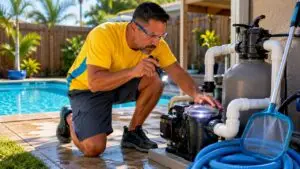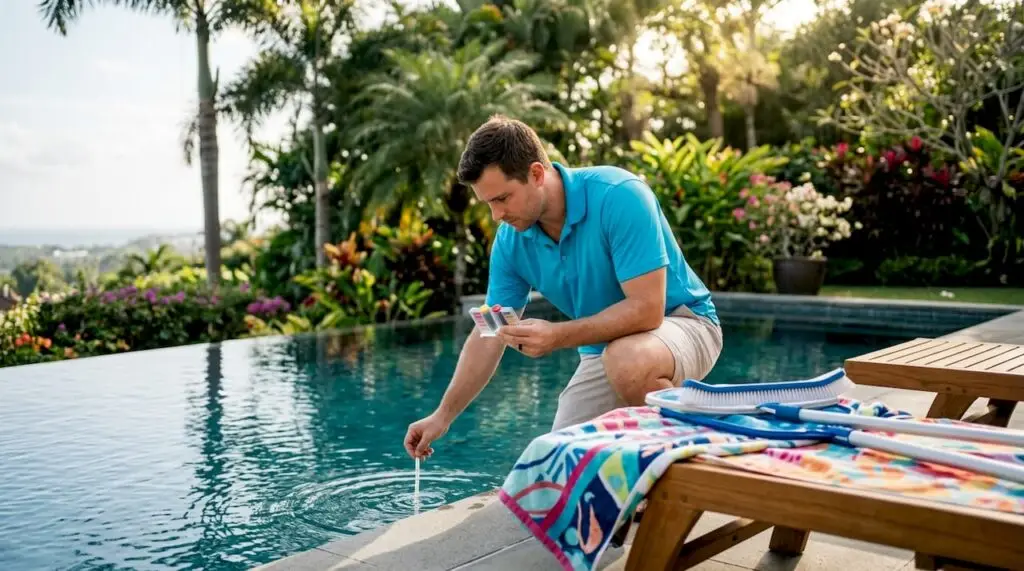
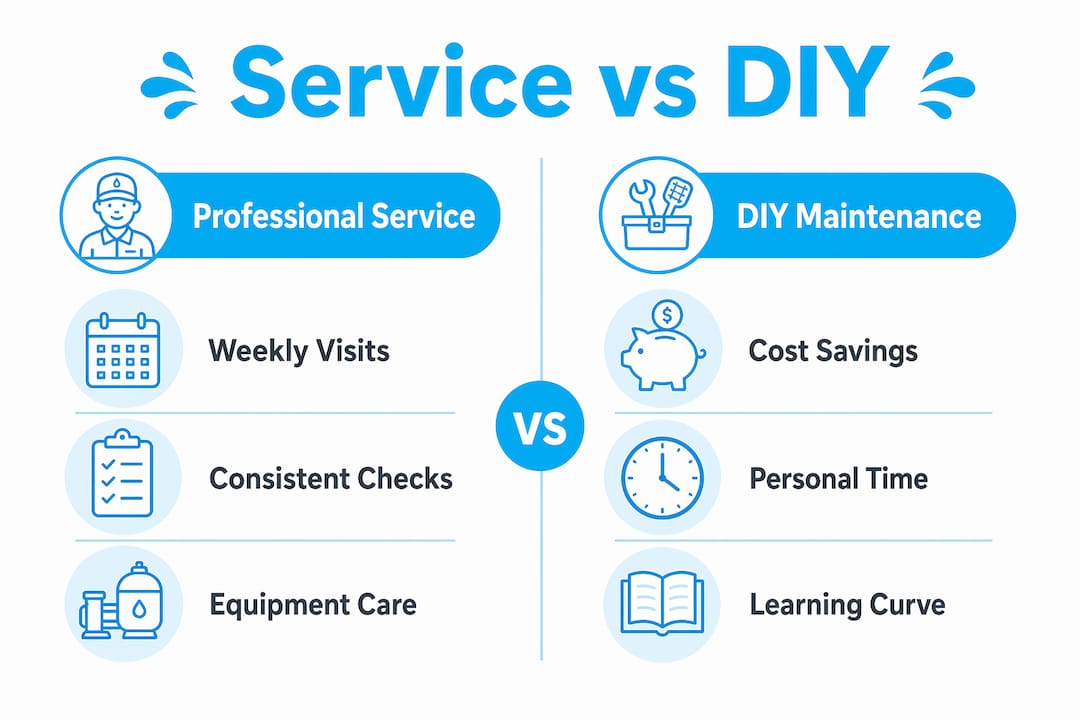
Professional pool service is defined as a recurring maintenance contract where a licensed technician handles water chemistry, cleaning, and equipment inspection on your behalf. DIY pool maintenance puts those same tasks in your hands, trading labor costs for personal time and a learning curve. The pool service vs diy explained debate comes down to three core trade-offs: cost, time, and technical confidence. Neither option is universally better. The right choice depends on your schedule, your comfort with pool chemistry, and how much risk you are willing to accept when something goes wrong.
What are the time and cost differences between DIY and professional pool service?
DIY pool maintenance saves roughly $1,200–$3,000 per year compared to weekly professional service, but it requires about 2–4 hours per week of hands-on work. That time commitment adds up to roughly 100–200 hours annually. For a busy household, that is a real cost even if it never shows up on a bank statement.
The numbers on the professional side are straightforward. Professional weekly service costs $80–$150 per week, which translates to $1,040–$2,600 per year for full-service plans. Cheaper “drive-by” chemical-only plans exist at lower price points, but they skip vacuuming, brushing, and equipment inspection. You pay less and get less.
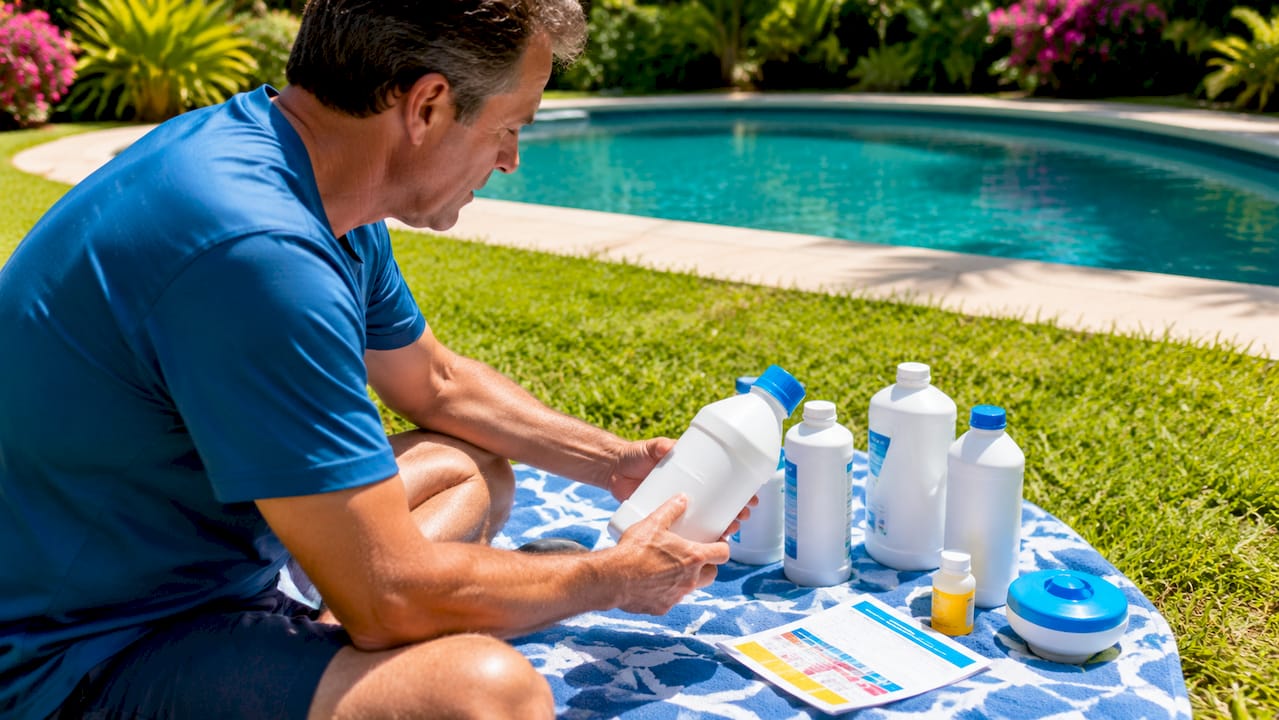
DIY supply costs run $400–$800 per year when you account for chlorine, pH adjusters, algaecide, test kits, and replacement parts. That figure assumes you buy correctly and do not over-dose chemicals due to misreading test results. Beginners often spend more in their first season because of trial and error.
Pro Tip: Price out your local pool supply store versus big-box retailers like Leslie’s Pool Supply before committing to a DIY budget. Bulk chlorine tablets and shock treatments are consistently cheaper at specialty stores, and staff can answer chemistry questions at no charge.
Regional pricing matters too. Pool service in Phoenix, Arizona runs toward the higher end of national averages because of year-round swim seasons and high demand. A homeowner in a northern state with a six-month season faces a very different annual cost equation. Factor your local climate into any pool maintenance comparison before deciding.
How does water chemistry management differ between DIY and professional pool care?
Water chemistry is the single area where DIY owners most often create expensive problems. DIY owners need to test free chlorine and pH about 2–3 times weekly during swim season, with other parameters tested monthly. Target ranges are specific: free chlorine at 2–4 ppm, pH at 7.4–7.6, total alkalinity at 80–120 ppm, and combined chlorine below 0.5 ppm. Drifting outside those ranges does not just make water look cloudy. It corrodes equipment, irritates swimmers, and feeds algae blooms.
Professional technicians test at every visit and adjust on the spot. They also recognize patterns. A pH that keeps climbing week after week signals a root cause problem, such as a high-alkalinity fill water source, not just a number to chase. That diagnostic instinct is hard to replicate from a YouTube tutorial.
Water quality testing should increase after storms, heavy pool use, or weather swings to prevent algae and maintain safety. Most DIY owners test on a fixed schedule and miss those spikes entirely. A single heavy-use weekend can consume enough chlorine to drop levels below the safe threshold by monday morning.
The correct DIY chemistry workflow matters as much as the testing frequency. Proper chemical adjustment follows a specific order: adjust total alkalinity first, then pH, then sanitizer, waiting about an hour between additions before retesting. Skipping that sequence causes fluctuating readings that send homeowners chasing numbers in circles for days.
“Water chemistry mistakes from inconsistent testing and dosing drive costly problems, making the decision about time availability, comfort with chemistry, and risk tolerance.” — Jas Aquatics
Pro Tip: Keep a simple chemistry log in a notebook or a free app. Recording your readings and what you added makes it far easier to spot trends and avoid the “why is my pH always high?” frustration that trips up most beginners.
You can find a detailed breakdown of recommended testing frequencies that aligns with both DIY schedules and professional service intervals.
What maintenance tasks do professional pool services handle that DIY owners often miss?
The real value of professional service is not just a clean pool on service day. Professional weekly visits cover water chemistry testing, wall brushing, vacuuming, basket cleaning, and visual equipment inspection to catch small problems before they become expensive repairs. DIY owners regularly skip one or more of those tasks, especially equipment inspection, because it is not obvious what to look for.
Filter care is the most commonly mismanaged task among homeowners. Filter backwashing should be triggered when pressure rises 8–10 PSI above the clean baseline, not on a fixed weekly schedule. Most DIY owners either backwash too often, which wastes water and disrupts the filter media, or not often enough, which leaves water cloudy and strains the pump. Sand and DE filters also require a rinse step after backwashing that many homeowners skip entirely.
Here is what a complete professional weekly visit typically covers:
- Water chemistry testing and adjustment (chlorine, pH, alkalinity, combined chlorine)
- Skimming the surface and emptying skimmer and pump baskets
- Brushing walls, steps, and waterline to prevent algae attachment
- Vacuuming the pool floor to remove settled debris
- Checking filter pressure and backwashing when the PSI threshold is reached
- Visual equipment inspection of pump, motor, heater, and automation systems
DIY owners often underestimate the importance of establishing a filter pressure baseline and recording it after a fresh clean. Without that baseline number, you have no reliable trigger for backwashing. Professionals record and track that figure automatically.
Seasonal services add another layer of value. Professional pool opening and closing services protect equipment from freeze damage, balance chemistry for the off-season, and catch any winter damage before it worsens. Missing a proper closing in a cold climate can crack pipes and void equipment warranties.
Pro Tip: Write your filter’s clean pressure on a piece of tape and stick it directly to the filter housing. That number is your backwash trigger. You want to backwash when the gauge reads 8–10 PSI above that baseline, not when the water looks off.
You can also review common pool repairs that result directly from skipped inspections and improper maintenance routines.
What hybrid approaches combine DIY and professional pool service?
A hybrid approach is defined as handling weekly DIY basics yourself while hiring professionals for seasonal services and equipment repairs. This model gives you the cost savings of DIY without abandoning expert oversight during the periods when your pool is most vulnerable.
Opening and closing a pool professionally costs $300–$700, while DIY supplies for the same tasks run $50–$100. Many homeowners find that paying for professional openings and closings while handling weekly maintenance themselves cuts their annual service bill significantly without sacrificing equipment protection.
The hybrid model works best when structured around clear responsibilities:
- DIY weekly tasks: skimming, basket emptying, chemistry testing, chemical adjustment, brushing
- Professional seasonal tasks: opening, closing, filter deep cleaning, equipment tune-ups
- Professional as needed: pump repairs, leak detection, heater service, automation troubleshooting
One underrated benefit of the hybrid approach is learning. Watching a professional technician work during a seasonal visit teaches you what to look for the rest of the year. Ask questions during those visits. A good technician will explain what they are checking and why, which makes your weekly DIY rounds more effective.
The pitfall to avoid is letting the hybrid model drift toward full DIY by skipping the professional seasonal visits to save money. Those visits are where early equipment problems get caught. Skipping them for two or three seasons often leads to a repair bill that wipes out years of savings.
Pro Tip: When you first get a pool, start with full professional service for one season before switching to DIY or hybrid. That first year teaches you what a properly maintained pool looks and feels like, giving you a reliable benchmark for your own work.
For a broader look at Austin pool maintenance routines that apply to warm-climate homeowners, the principles of consistent chemistry testing and seasonal professional support translate directly to Arizona and similar markets.
Key takeaways
Professional pool service and DIY maintenance each deliver real value, and the best choice depends on your time, budget, and chemistry confidence.
| Point | Details |
|---|---|
| Cost difference is significant | DIY costs $400–$800 per year versus $1,040–$2,600 for full professional service. |
| Time is a real trade-off | DIY requires 2–4 hours per week; professional service requires zero homeowner labor. |
| Chemistry sequence matters | Adjust alkalinity first, then pH, then sanitizer, waiting an hour between additions. |
| Filter care needs a baseline | Record clean filter pressure and backwash only when PSI rises 8–10 above that number. |
| Hybrid often fits best | DIY weekly tasks plus professional seasonal services balance cost and expert oversight. |
What I’ve learned after watching hundreds of pool owners make this decision
After a decade working with homeowners across the Greater Phoenix area at Wefixuglypools, I have seen the same pattern repeat itself. Homeowners switch to DIY to save money, do well for a season or two, then hit a problem they cannot diagnose. By the time they call us, a small equipment issue has become a repair that costs more than two years of professional service would have.
The part that surprises most people is this: the biggest risk in DIY pool care is not dirty water. It is missed equipment problems. A pump running hot, a slow leak at a fitting, a filter pressure that keeps climbing. Those are the issues that compound quietly until they fail completely. Professional technicians catch them during routine visits because they know what normal looks like on your specific equipment.
My honest recommendation for most homeowners is to start with professional service, learn your pool’s chemistry patterns and equipment quirks, then transition to a hybrid model after one full season. You will be a far more effective DIY owner because you will know your pool’s baseline behavior. Jumping straight into full DIY without that foundation is where most people run into trouble.
The dangers of improper pool service go beyond green water. Corrosion, cracked fittings, and voided equipment warranties are the real consequences of inconsistent maintenance. Whether you choose DIY, professional, or hybrid, consistency is the one factor that determines long-term pool health more than anything else.
— Brian
Your pool deserves more than just clean water
A well-maintained pool is only part of the picture. If your pool’s surface, tile, or structure is showing its age, no amount of weekly cleaning will make it look the way it should.
Wefixuglypools has spent over a decade transforming worn, unappealing pools across the Greater Phoenix area into spaces homeowners are proud to use. From full pool remodeling and restoration to targeted pool repair services, we handle the work that goes beyond routine maintenance. If your pool needs more than a chemical adjustment, our team is ready to assess what it actually needs and give you a clear path forward. Reach out to Wefixuglypools and find out what your pool could look like.
FAQ
How much does DIY pool maintenance cost per year?
DIY pool maintenance typically costs $400–$800 per year in chemicals and supplies. That figure assumes correct chemical dosing and no major equipment repairs.
Is professional pool service worth the cost?
Professional service costs $1,040–$2,600 annually but eliminates weekly labor and provides consistent equipment oversight. For homeowners with limited time or low chemistry confidence, it is worth the premium.
How often should I test my pool water?
Test free chlorine and pH 2–3 times per week during swim season, and increase testing frequency after storms, heavy use, or significant weather changes. Test other parameters like total alkalinity monthly.
What is a hybrid pool maintenance approach?
A hybrid approach means handling weekly cleaning and chemistry yourself while hiring professionals for seasonal opening, closing, and equipment repairs. It reduces annual costs while keeping expert oversight during critical periods.
What is the correct order for adding pool chemicals?
Adjust total alkalinity first, then pH, then chlorine sanitizer. Wait approximately one hour after each addition before retesting to avoid chasing fluctuating readings.