Pool service plan options are categorized into three primary tiers: Chemical-Only, Maintenance, and Full-Service plans, each designed to match a different level of care, budget, and homeowner involvement. Choosing the wrong tier costs more than you expect, whether through algae treatments, voided equipment warranties, or surprise add-on fees. This guide breaks down every tier, explains what each one actually covers, and gives you the criteria to pick the right monthly pool service package for your pool’s size, age, and how often you use it.
1. What are the main pool service plan options?
Pool service plans fall into three standard tiers recognized across the industry: Chemical-Only, Maintenance (also called Brush and Basket), and Full-Service. Each tier builds on the last, adding tasks and protections that shift responsibility from the homeowner to the professional.
Chemical-Only plans cover water testing and chemical balancing on a weekly or bi-weekly basis. The technician arrives, tests your water, adjusts chlorine and pH levels, and leaves. Skimming, vacuuming, and basket cleaning are your responsibility. These plans carry the lowest monthly rate but the highest homeowner workload.
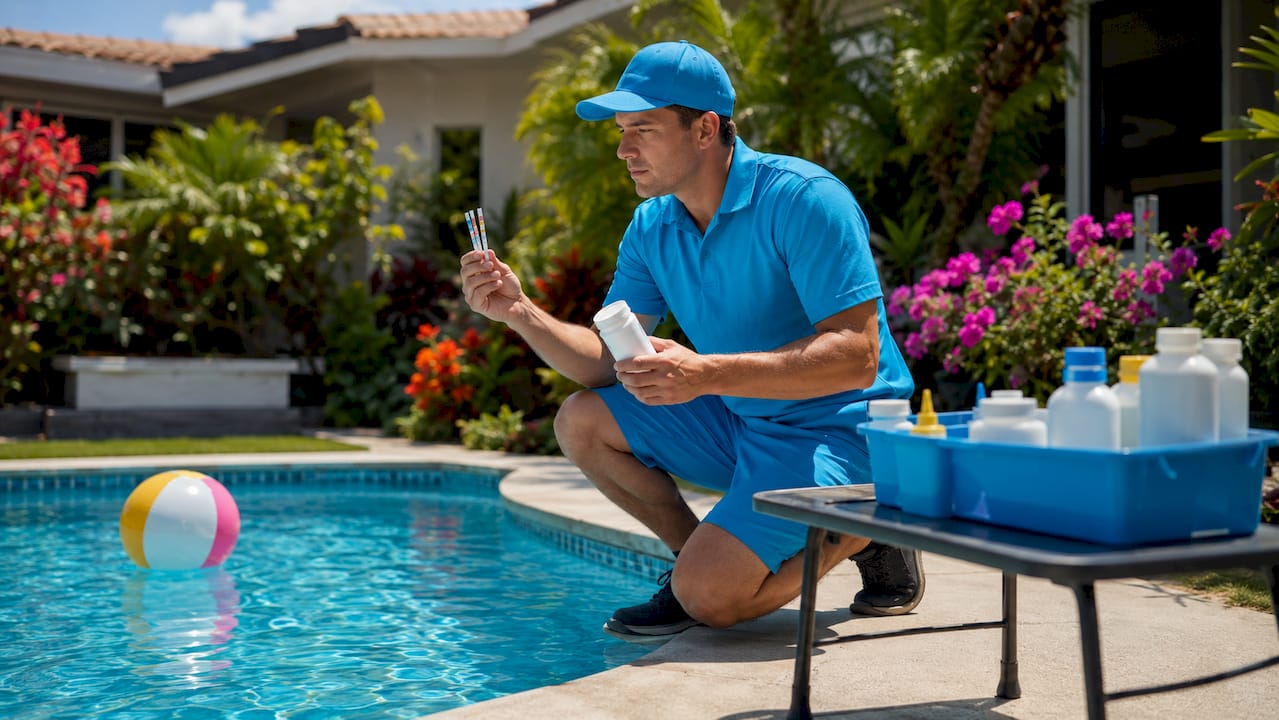
Maintenance plans add physical cleaning tasks to the chemical work. Expect skimming the surface, brushing walls and steps, and emptying pump and skimmer baskets. This tier suits homeowners who want cleaner water without doing the hands-on work themselves, but who are still comfortable monitoring equipment.
Full-Service plans are the most complete option. Full-service coverage typically includes skimming, vacuuming, brushing, chemical balancing, basket cleaning, and equipment inspection every visit. According to industry data, full-service plans usually include 2–4 professional filter cleanings per year, which would cost $150–$400 each if billed separately. That bundled value adds up fast.
Pro Tip: Ask any provider to give you a written list of every task performed on each visit before you sign. Verbal promises about “full service” vary widely between companies.
2. How do pricing structures vary among pool service plan options?
Standard weekly pool service costs $80–$150 per month depending on pool size and your region. Pools over 20,000 gallons or those with attached spas generally exceed that base rate due to added complexity. That monthly figure is the starting point, not the total cost.
The real cost picture emerges when you factor in add-ons. Specialty chemicals like stain removers and phosphate treatments are commonly excluded from base plans and add $100–$300 annually. Filter cleanings, if not bundled, run $150–$400 each. A plan advertised at $100 per month can easily cost $1,800 or more per year once those extras are billed.
| Plan Type | Avg. Monthly Cost | Filter Cleaning | Specialty Chemicals | Equipment Inspection |
|---|---|---|---|---|
| Chemical-Only | $60–$90 | Not included | Not included | Not included |
| Maintenance | $90–$130 | Not included | Not included | Basic check only |
| Full-Service | $130–$200+ | 2–4 times/year | Sometimes included | Full inspection |
Cheaper monthly rates can lead to higher total costs once add-ons and surprise fees accumulate over the year. The only way to compare plans fairly is to calculate the full annual cost, not the advertised monthly rate.
Pro Tip: Request an itemized annual cost estimate from every provider you consider. Add up base fees, filter cleanings, and average chemical add-ons to get a true comparison.
3. Why weekly service matters more than you think
Weekly pool visits of 30–45 minutes are the industry standard for preventing algae blooms, equipment damage, and warranty voidance. Skipping to bi-weekly service saves roughly $50 per month on paper. In practice, a single algae treatment costs $300–$800, wiping out months of savings in one visit.
Equipment warranties are the less obvious risk. Many pump and heater manufacturers require documented professional service to honor warranty claims. Lower-tier plans that exclude vacuuming and basket cleaning shift that liability back to you, and neglecting those tasks can void manufacturer warranties on pumps and heaters.
Here is a direct comparison of weekly versus bi-weekly service:
Weekly service:
- Consistent water chemistry prevents algae and bacterial growth
- Early detection of equipment issues before they become expensive repairs
- Maintains warranty compliance with most major equipment manufacturers
- Keeps your pool ready to use at any time without advance preparation
Bi-weekly service:
- Lower monthly cost (roughly $50 savings per month)
- Higher risk of algae blooms between visits, especially in summer heat
- Reduced opportunity for early equipment failure detection
- May not satisfy warranty requirements for pumps, heaters, and filters
“Consistent weekly service is the single most effective way to prevent the kind of equipment failures that cost homeowners thousands of dollars in repairs.” — Industry standard guidance from pool service professionals
4. How to choose the right plan for your pool
The right plan depends on four factors: pool size, pool features, how often you use it, and how much you want to do yourself. Matching those factors to a tier prevents overpaying for coverage you do not need or underpaying until something breaks.
-
Pool size under 15,000 gallons, light use, hands-on owner. A Maintenance plan covers the physical cleaning while you handle minor chemical adjustments between visits. This is the most affordable pool service option for smaller, straightforward pools.
-
Pool size 15,000–25,000 gallons, moderate use, average involvement. A Full-Service plan makes sense here. The added complexity of a larger volume means chemical balance shifts faster, and weekly equipment checks catch problems early.
-
Pool with a spa, water features, or enclosure. Go Full-Service without question. Spas require separate chemical management, and custom pool features like fountains and waterfalls add mechanical components that need regular inspection.
-
Vacation home or seasonal use pool. A Full-Service plan with documented equipment inspections protects a pool that sits unused for months. Equipment inspections checking filter pressure and valve integrity prevent expensive repairs and support warranty claims, which matters most when no one is watching the pool daily.
-
Heavy-use pool with kids, guests, or frequent parties. Full-Service weekly is the only responsible choice. High bather loads spike chemical demand and accelerate debris accumulation. Bi-weekly service cannot keep pace.
-
Budget-constrained homeowner with a newer pool. Start with a Maintenance plan and add filter cleaning as a scheduled add-on twice per year. Track your actual chemical add-on costs for three months, then reassess whether upgrading to Full-Service saves money overall.
-
Older pool with aging equipment. Full-Service plans with documented inspections are worth every dollar. Recurring professional inspections are critical preventative measures that safeguard pool systems and support warranty maintenance, which is especially valuable when equipment is approaching the end of its service life.
Key takeaways
The most cost-effective pool service plan is the one that matches your pool’s complexity to the right service tier, calculated on annual cost rather than monthly rate.
| Point | Details |
|---|---|
| Three standard tiers exist | Chemical-Only, Maintenance, and Full-Service plans cover increasing levels of care and responsibility. |
| Annual cost beats monthly rate | Add filter cleanings and specialty chemicals to the base rate before comparing any two plans. |
| Weekly service protects warranties | Bi-weekly service risks algae treatment costs of $300–$800 and may void equipment warranties. |
| Pool complexity drives tier choice | Spas, water features, and older equipment require Full-Service plans with documented inspections. |
| Technician consistency adds value | A consistent technician learns your pool’s unique behavior and catches problems earlier. |
What I have learned after years of watching homeowners choose the wrong plan
Most homeowners pick a plan based on the monthly price they see in an ad. That is the single most expensive mistake you can make with pool care. The advertised rate almost never reflects what you will actually pay by december.
Here is what I have seen repeatedly: a homeowner signs up for a Chemical-Only plan to save $40 per month. By summer, they are dealing with a green pool, a $500 algae treatment, and a pump warranty claim that gets denied because there are no documented service records. The “savings” cost them over $1,000 in a single season.
Documented service logs protect your investment and support warranty claims. That is not a bonus feature. It is a core reason to choose a provider who delivers written reports after every visit, not just a text saying “your pool looks great.”
The other thing most articles skip: technician consistency matters more than the plan tier itself. A consistent technician who knows your pool’s flow rates, valve positions, and equipment quirks will catch a failing seal or a pressure spike that a rotating crew would walk right past. When you interview providers, ask directly whether you will have the same technician each week. If they cannot commit to that, factor it into your decision.
My honest recommendation is to start one tier higher than you think you need. The difference between a Maintenance plan and a Full-Service plan is often $30–$50 per month. The difference in protection, documentation, and peace of mind is far greater than that gap suggests.
— Brian
Ready to take your pool from overlooked to outstanding?
If your pool needs more than a service plan, Wefixuglypools has spent over a decade transforming pools across the Greater Phoenix area. We specialize in pool remodeling and restoration that addresses both the appearance and the safety of your pool, from resurfacing and tile work to full equipment upgrades.

Whether you are starting fresh with a new build or bringing an aging pool back to life, our team delivers the kind of hands-on expertise that comes from completing hundreds of transformations. Contact Wefixuglypools today to get a custom quote and find out which service and maintenance solution fits your pool, your budget, and your goals.
FAQ
What does a full-service pool plan typically include?
A full-service plan includes skimming, vacuuming, brushing, chemical balancing, basket cleaning, and equipment inspection on every visit. Most providers also bundle 2–4 filter cleanings per year into the plan.
How much does monthly pool service cost in 2026?
Standard weekly service costs $80–$150 per month for most residential pools. Pools with spas or over 20,000 gallons typically exceed that range due to added complexity.
Is bi-weekly pool service enough to keep a pool clean?
Bi-weekly service saves roughly $50 per month but increases the risk of algae blooms that cost $300–$800 to treat. For most pools, weekly service is the more cost-effective choice over a full year.
What is usually not included in a base pool service plan?
Specialty chemicals like stain removers and phosphate treatments are commonly excluded and add $100–$300 per year. Filter cleanings are also frequently billed as add-ons unless you are on a Full-Service plan.
Does pool service affect my equipment warranty?
Yes. Many pump and heater manufacturers require documented professional service records to honor warranty claims. Choosing a plan that excludes vacuuming or equipment inspections can leave you without coverage when you need it most.