For most residential pools, a cartridge filter hits the sweet spot between clean water, low water waste, and manageable upkeep. But your best pick depends on your pool and habits.
- Sand: best for heavy debris, low fuss, tight budgets.
- Cartridge: best for water-conscious owners, spas, and hands-off maintenance.
- DE: best for owners chasing showroom-clear water who don’t mind extra steps.
Fineness varies a lot: sand filters catch particles around 20 to 40 microns, cartridges around 10 to 15, and DE down to roughly 2 to 5, according to AllFilters.
Key Takeaways
The right pool filter is the one sized to your pump’s flow and maintained on schedule, not necessarily the one with the finest micron rating on the label.
| Point | Details |
|---|---|
| Cartridge fits most homes | No backwash water loss, filters to about 10 to 15 microns, ideal for spas too. |
| Sand suits heavy debris | Lowest upfront cost, filters to about 20 to 40 microns, needs regular backwashing. |
| DE delivers the clearest water | Filters down to about 2 to 5 microns but demands grid teardowns and careful powder handling. |
| Size beats micron rating | An undersized or neglected fine filter often performs worse than a properly sized coarser one. |
| Wefixuglypools handles sizing and installs | We assess flow, plumbing, and equipment fit before recommending or installing a replacement filter. |
Table of Contents
- How Pool Filtration Actually Works
- Sand Filters: Simple, Sturdy, and a Little Coarse
- Cartridge Filters: The Low-Water, Low-Fuss Middle Ground
- DE Filters: The Clearest Water, With Strings Attached
- How to Choose the Right Filter for Your Pool
- What Maintenance and Costs Actually Look Like
- Why Sizing Beats the Micron Number on the Box
- Get Your Filter Sized and Installed Right
- Sources
How Pool Filtration Actually Works
Your pump pulls water through the skimmer and main drain, pushes it through the filter media, and sends clean water back through the return jets. The filter is just one link in that loop, but it’s the link that decides whether your water looks inviting or cloudy.
A few things drive real-world performance more than the filter type alone:
- Flow rate — how many gallons per minute your pump pushes through the system.
- Filter surface area — more area means longer runs between cleanings.
- Baseline pressure — know your clean-filter PSI so you can spot when it’s time to service.
Sand Filters: Simple, Sturdy, and a Little Coarse
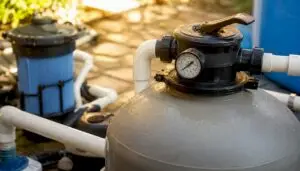
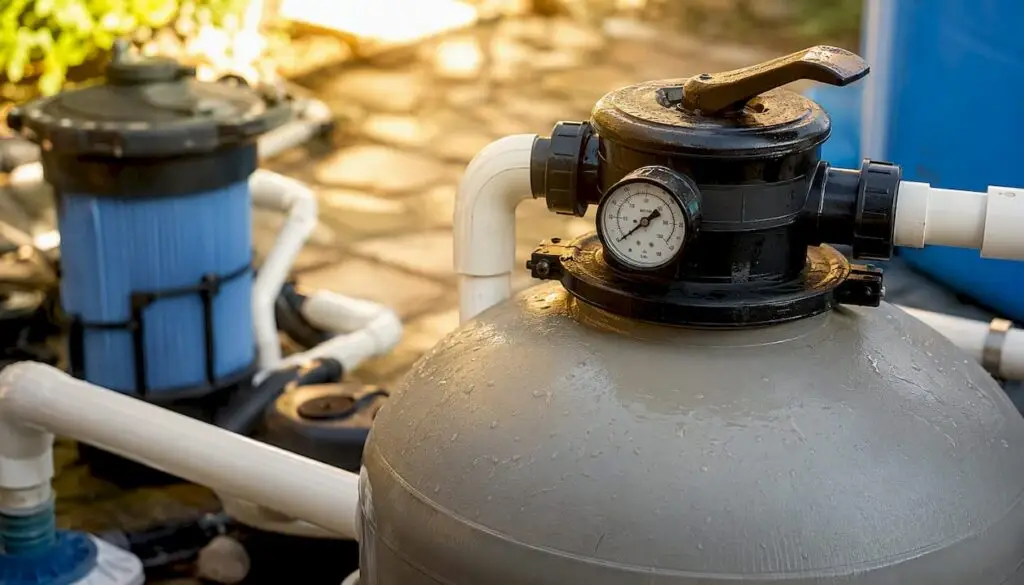
A sand filter pushes water down through a bed of specially graded sand, called No. 20 silica sand, that traps debris as it passes. When pressure builds, you reverse the flow to backwash the trapped gunk out through a waste line.
Sand filters typically remove particles down to about 20 to 40 microns, per AllFilters. That’s coarse enough to leave water looking merely “clear” rather than glassy, but plenty good for most backyard pools.
Pros:
- Lowest upfront cost of the three types
- Extremely durable, with little to break
- Backwashing is a simple valve turn, no disassembly
Cons:
- Coarsest filtration of the group
- Backwashing wastes water and pool chemicals every time
Quick fact: Sand media typically needs replacing every 3 to 7 years, and a single backwash cycle can use somewhere between 200 and 500 gallons of water, according to AllFilters.
Upfront cost tends to run lowest among the three options, with recurring costs limited to occasional sand swaps and the water lost each time you backwash. Swapping standard sand for glass or anthracite media can improve fineness and reduce backwashing frequency, according to Fluidra.
Cartridge Filters: The Low-Water, Low-Fuss Middle Ground
Cartridge filters work by forcing water through pleated polyester elements. That folded design packs a large surface area into a compact tank, and it never needs backwashing.
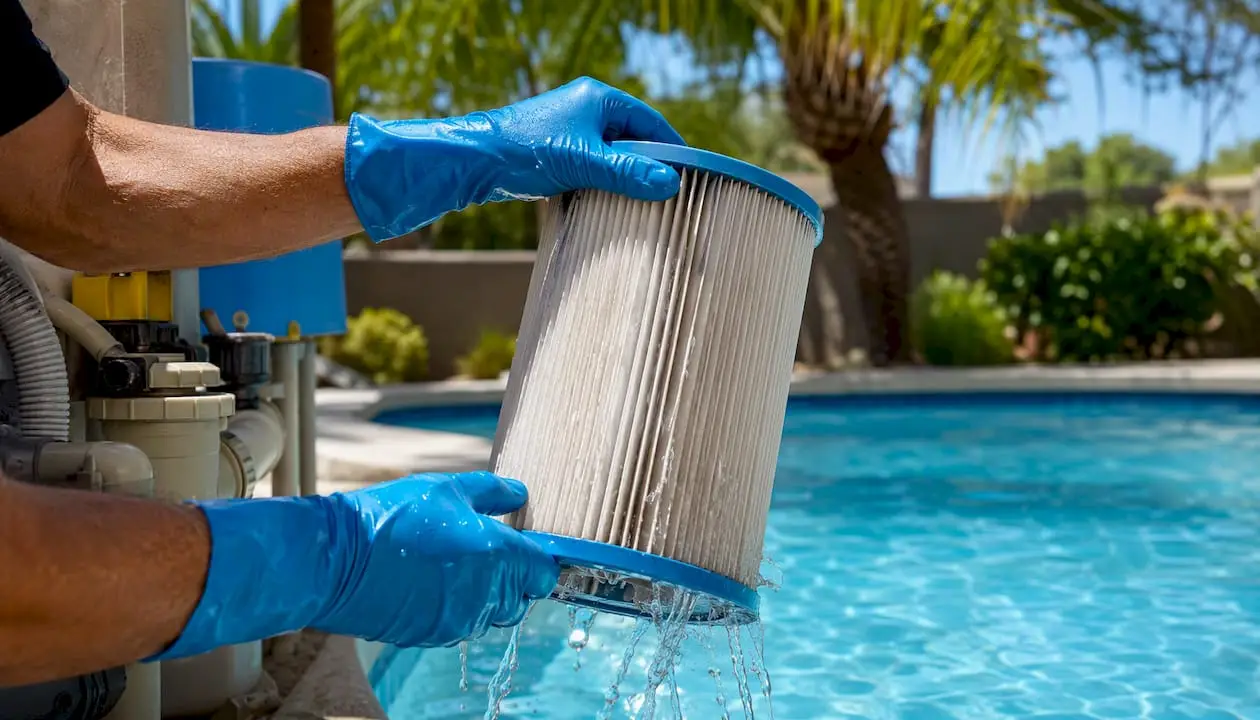
Filtration typically lands around 10 to 15 microns, according to AllFilters, noticeably finer than sand. That extra fineness, combined with zero backwash water loss, is why cartridge units have become the default choice for many new residential builds.
Pros:
- No backwashing means real water savings over a season
- Cleaning just means hosing off the element
- Handles oils and lotions well, which is why it’s a favorite for spas and hot tubs
Cons:
- Elements need regular rinsing and occasional deep soaking in cleaner
- Elements eventually wear out and need replacing
Quick fact: Cartridge elements generally last 2 to 5 years with proper care, per AllFilters, though some owners get closer to 1 to 3 years without regular rinsing.
Sizing matters here more than almost anywhere else. A good rule of thumb is roughly one square foot of cartridge surface area for every gallon-per-minute of flow. Undersize it, and you’re back to backwash-level performance despite the finer media.
DE Filters: The Clearest Water, With Strings Attached
Diatomaceous earth filters coat internal grids with a fine powder made from fossilized algae. Water passes through that DE coating, and the result is the finest filtration of the three, capturing particles down to roughly 2 to 5 microns, per PoolFilterGuide.
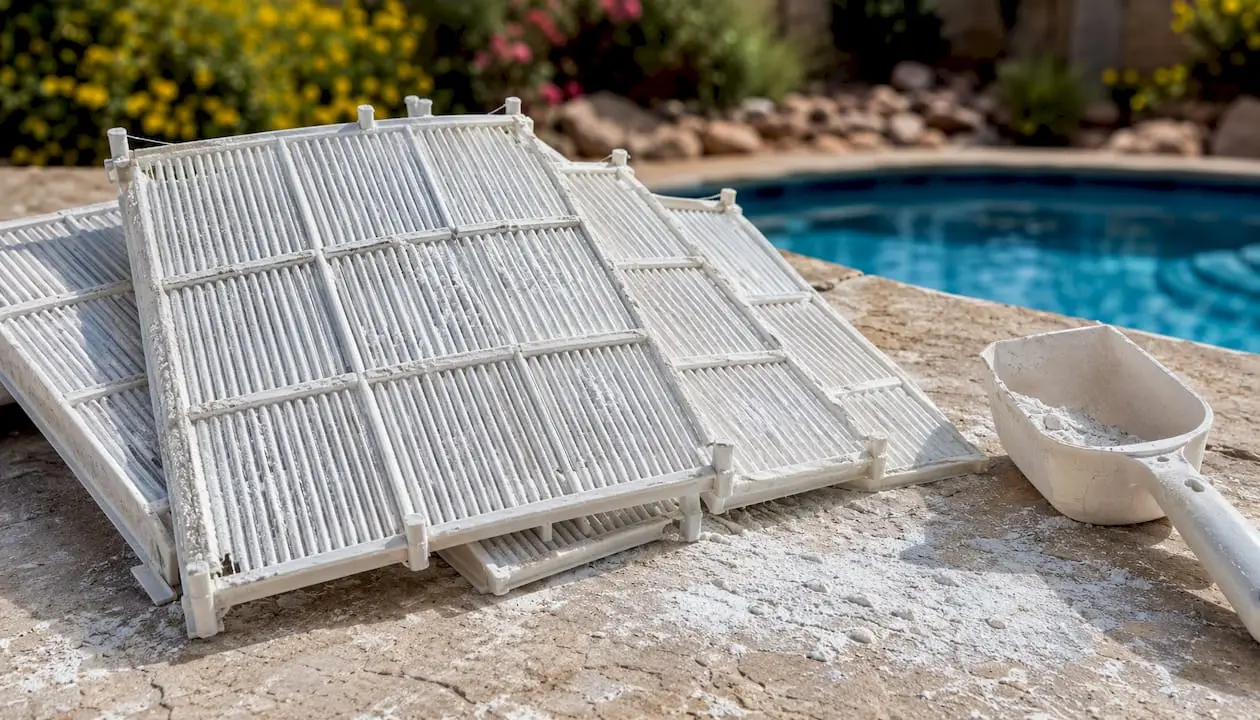
That clarity comes at a price in effort. After backwashing, you have to recharge the grids with fresh DE powder, and every few seasons the grids need a full teardown and cleaning.
Pros:
- The clearest, most “polished” water of any residential option
- Grids can last 3 to 10 years with proper care, according to BHG
Cons:
- Most labor-intensive maintenance routine of the three
- Handling and disposing of DE powder requires care
DE dust is fine enough to be harmful if inhaled, so follow manufacturer safety guidance whenever you handle or recharge it, and never run flocculants through a DE-coated grid, since the floc can harden and cement the DE into an unusable clog, per BHG.
How to Choose the Right Filter for Your Pool
Run through this checklist before you decide:
- Pool size and volume — bigger pools need more surface area, regardless of filter type.
- Backwash drain access — no easy drain or septic restrictions push you toward cartridge.
- Water-use rules — if your area limits water use, skip the backwash-heavy options.
- Bather load — heavy use (kids, parties, pets) favors finer filtration and more frequent cleaning.
- Budget and time — sand costs less upfront, DE costs more in labor, cartridge sits in between.
The single sizing rule that matters most: match the filter to your pump’s flow rate, not just your pool’s gallon count. A too-small filter, of any type, causes chronic high pressure and shorter service life, according to Beltway Pools. When in doubt, size up on surface area rather than down.
Heavy-debris pools near trees usually do best with sand. Homes on water restrictions or spa owners usually do best with cartridge. Owners who want visibly perfect water and don’t mind extra maintenance steps usually do best with DE.
What Maintenance and Costs Actually Look Like
| Task Type | Sand | Cartridge | DE |
|---|---|---|---|
| Weekly | Check pressure gauge regularly | Check pressure gauge regularly | Check pressure gauge regularly |
| Backwash/clean | Every few weeks | Rinse element every couple of weeks | Backwash every several weeks plus recharge |
| Annual | Deep clean, check sand | Deep-soak clean, inspect for tears | Full grid teardown and inspection |
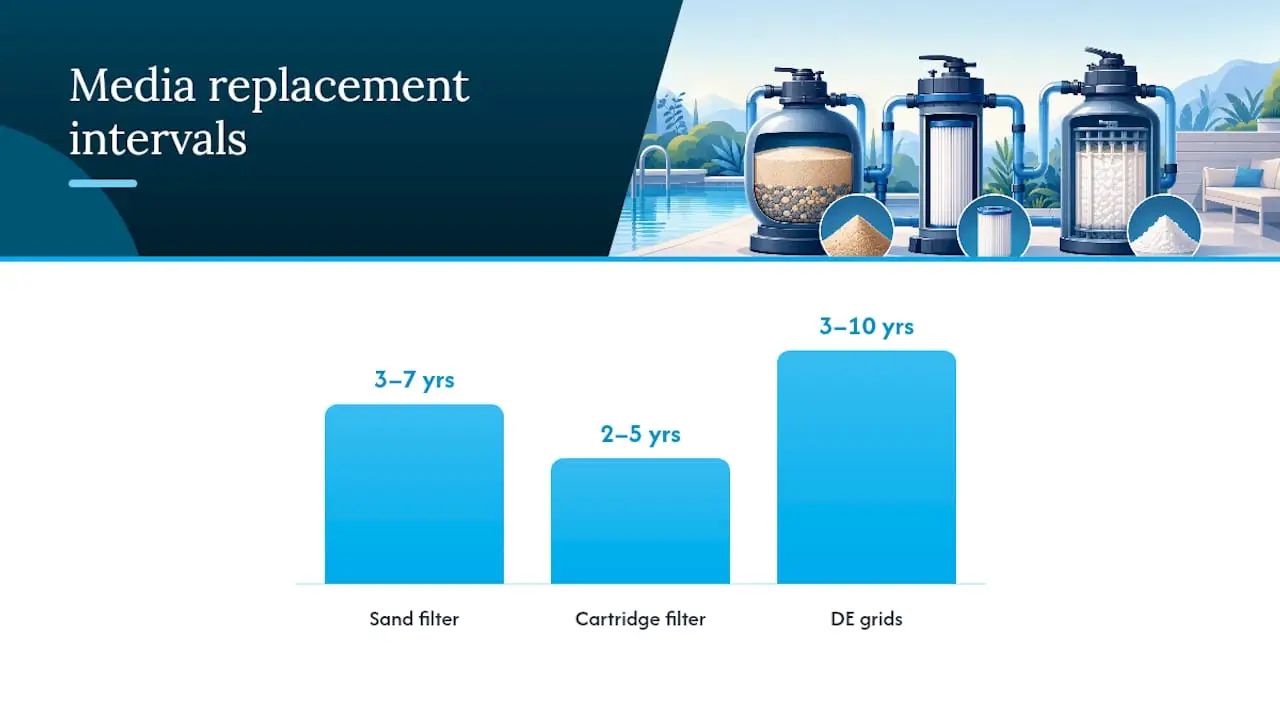
| Media replacement | Every 3 to 7 years | Every 2 to 5 years | Grids every 3 to 10 years |
Cartridge filters save the most water over a season since they skip backwashing entirely, while sand and DE both lose water and treated chemicals every cycle.
Pro Tip: Write your clean-filter pressure reading on the tank with a marker. Once pressure climbs 8 to 10 PSI above that baseline, it’s your cue to clean or backwash, no matter what the calendar says.
Why Sizing Beats the Micron Number on the Box
A properly sized, well-maintained cartridge filter regularly outperforms an undersized or neglected DE system, even though DE has the finer micron rating on paper, according to AllFilters.
Pro Tip: Prioritize surface area and a consistent cleaning schedule over chasing the smallest micron figure. A neglected fine filter clouds up faster than a well-kept coarse one.
When We Recommend Each Filter Type
We generally point budget-focused owners with heavy debris toward sand, water-conscious owners and spa owners toward cartridge, and clarity-obsessed owners toward DE. If your filter is undersized or your plumbing is fighting your pump, that’s usually a sign it’s time for an equipment upgrade, not just a new filter.
Get Your Filter Sized and Installed Right
Wefixuglypools is the alternative to guessing your way through a filter upgrade: instead of piecing together sand, cartridge, or DE specs on your own, you get a pro assessment that matches your equipment to your actual pump flow and plumbing, not just your pool’s gallon count.
We handle equipment assessments, filter replacement, plumbing unions, and full installs across the Greater Phoenix area, and we’ve seen firsthand how often “bad water” turns out to be an undersized or mismatched filter rather than a dirty one. If your pressure gauge is constantly climbing, your backwash cycles feel nonstop, or you’re planning a bigger remodel anyway, it’s worth a professional sizing check before you buy new equipment. Our pool remodeling and restoration services cover exactly this kind of equipment upgrade, from filter swaps to full plumbing rework. Reach out for a sizing check and quote, and get equipment that actually matches your pool instead of a best guess.
Sources
- Pool Filter Types Compared: Sand, DE, Cartridge
- Types of pool filters and how to choose the best one for your pool
- How to Choose a Pool Filter – Sand, Cartridge, or DE?
- The Best Pool Filter Buying Guide
- Sand vs. Cartridge vs. DE Pool Filters | Beltway Pools